Why Achilles Pain Eases During Running, Then Bites
By the Zetra Coaching Team
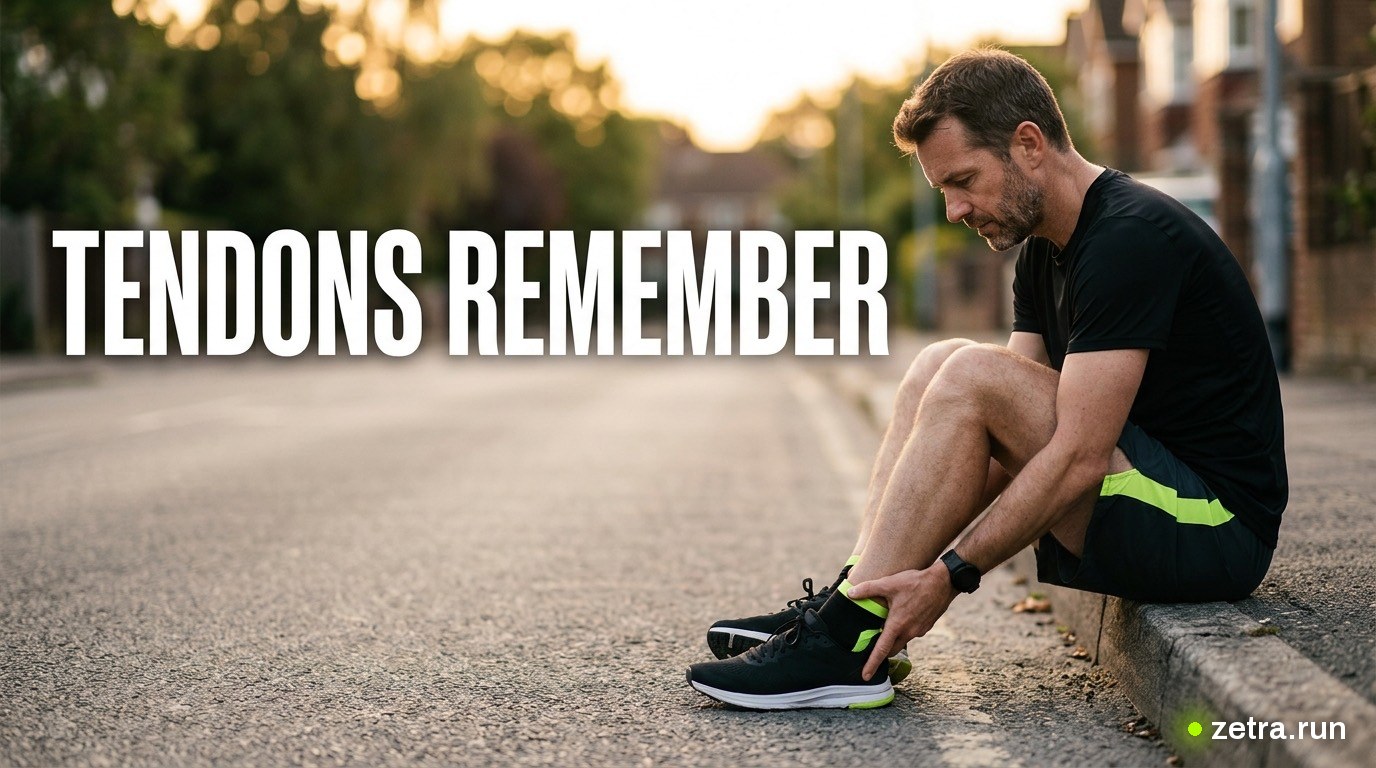
An Achilles that warms up during the run and stiffens afterwards is telling you something specific.
Achilles pain with running is a warning sign when it follows this pattern: stiff in the morning, tender on the tendon itself, uncomfortable at the start of a run, easier once warm, then sore again hours later or the next morning. That “it felt better once I got going” feeling does not always mean it is improving. It often means the tendon tolerated the run while warm, then reacted to the load afterwards.
What runners often call Achilles tendinopathy describes a pattern of pain, not a confirmed diagnosis. Several different problems can feel similar around the heel, calf, ankle, or tendon. If the pain is persistent, worsening, sharp, or changing how you walk, see a physiotherapist or doctor.
Why does Achilles pain during running warm up and come back later?
Achilles pain often warms up because tendons can feel better once blood flow, temperature, and movement increase. That does not prove the tendon is happy with the load.
The classic runner pattern looks like this: you get out of bed and the first steps feel stiff. You prod the back of your ankle and find a sore spot on the tendon. The first few minutes of running feel tight or painful. Then the discomfort fades. You finish the run thinking you got away with it.
Later, it comes back.
Maybe it aches that evening. Maybe stairs feel worse. Maybe the next morning is stiffer than the last one. That delayed reaction matters. Your Achilles is giving feedback on the total load it had to handle, not just how it felt during the warm part of the run.
The Achilles tendon is the thick cord that connects your calf muscles to your heel bone. It stores and releases energy every time you push off. It is the strongest tendon in the body, but that does not mean it adapts quickly.
Muscle fitness can improve faster than tendon tolerance. Your breathing may feel ready for more running. Your legs may feel springy. Your watch may say your fitness is rising. The tendon still needs time to remodel and get used to repeated force.
That gap is where runners get caught.
You add mileage. You add hills. You add speed work. You switch to lower-drop shoes. You return after time off and try to run like the old version of yourself. Your lungs say yes. Your Achilles says, slowly, no.
What are the Achilles warning signs runners should not ignore?
The warning sign is the pattern, especially when it repeats. A one-off tight calf after a hard run is different from a tendon that keeps giving you the same message.
Pay attention to what you feel, when you feel it, and what happens the next day.
| What you feel and when | What it commonly suggests | What to do next |
|---|---|---|
| Morning stiffness near the back of the ankle or heel | The tendon or nearby tissue may be reacting to recent load | Reduce the runs or workouts that seem to aggravate it and monitor whether the next morning improves |
| Tenderness when you press on the Achilles tendon itself | The tendon may be irritated, though this is not a diagnosis | Stop poking it repeatedly, back off aggravating load, and consider seeing a physiotherapist if it persists |
| Pain at the start of a run that eases after warming up | The tendon may be tolerating movement while warm but still reacting later | Do not use “it warmed up” as the only green light; judge the run by the hours after and the next morning |
| Pain that returns after the run or the next morning | The total load was likely too much for the tendon right now | Ease off hills, speed, and volume while you decide whether running is helping or feeding the problem |
| Sudden sharp pain, a snapping or popping sensation, or trouble pushing off | This can signal a more serious injury | Stop running and seek immediate medical assessment |
| Pain that changes your stride or makes walking abnormal | You are no longer just managing mild soreness | Stop self-managing and see a physiotherapist or doctor |
| Swelling, heat, spreading pain, numbness, or symptoms that do not settle | Something else may be going on | Get assessed rather than guessing |
The big mistake is treating the warm-up effect as proof that the problem is gone.
A tendon can feel better mid-run and still be worse tomorrow. That is why your next-morning stiffness is useful information. So is how you feel going down stairs, walking after sitting, or doing your first few steps out of bed.
You are looking for a trend. Less stiffness. Less tenderness. Less reaction after similar or easier running. If the trend is going the other way, the plan needs to change.
For a broader check on symptoms that should not be trained through, read pain red flags.
Why did my Achilles start hurting after more mileage, hills, speed work, or new shoes?
Your Achilles usually complains when the load changes faster than the tendon can adapt.
That change can be obvious: more running, harder workouts, steeper routes. It can also be sneaky. You run the same distance but add hill repeats. You keep the same plan but start doing faster finishes. You swap shoes and the new pair asks more from your calf and Achilles. You come back from a break and your aerobic system returns faster than your tendon capacity.
Lower-drop shoes are a common trigger for some runners. They can put the ankle in a position that asks the calf and Achilles to work differently. That does not make lower-drop shoes bad. It means changing footwear is still a training change. Your tendon does not care whether the load came from a workout, a route, or a shoe.
Hills matter because climbing increases the demand on your calf and Achilles. Speed matters because faster running usually means higher force through the lower leg. Sudden jumps in either can expose a tendon that was coping fine with easy flat running.
This is also why the usual “just rest until it feels better” approach can fail.
Rest may calm symptoms. It does not automatically rebuild the tendon’s tolerance for running. If you stop completely, wait until it feels quiet, then return to the same hills, pace, and volume, the same warning signs may come back.
The better question is: which load is the tendon reacting to?
For one runner, it is the hilly route. For another, it is speed work. For another, it is stacking runs too close together. For a returning runner, it may simply be doing too much too soon after time away. If that sounds familiar, returning after injury is worth reading next.
Can you keep running with Achilles pain?
Sometimes you can keep running in a reduced, careful way, but only if symptoms are mild, do not change your stride, and do not worsen afterwards or the next morning. If pain is sharp, escalating, or affecting how you walk, stop and get assessed.
This is the part runners hate because it is not a clean yes or no.
You do not need to panic at the first hint of stiffness. You also should not keep proving your toughness on a tendon that is getting louder. The goal is to reduce the specific load that is irritating it while keeping as much safe movement as your body tolerates.
Common load changes include:
- Swap hills for flatter routes for a while.
- Pause speed work and hard finishes.
- Shorten runs if the tendon reacts later.
- Add more easy days between run days if back-to-back running seems to flare it.
- Avoid testing it every day with jumps, sprints, or aggressive calf work.
- Keep notes on morning stiffness, tenderness, and post-run reaction.
Notice what is missing: a promise that one trick fixes it.
Achilles problems commonly take weeks rather than days to settle, and some cases take much longer. That does not mean you are broken. It means tendon adaptation is slow.
The tendon needs enough load to adapt, but not so much that it stays irritated. That line is hard to find on your own because the feedback is delayed. You may feel fine at minute one of the run and learn the truth the next morning.
If you are also dealing with lower-leg pain away from the Achilles, compare the pattern with shin splints. Different tissues can complain for different reasons, and guessing wrong can keep you stuck.
What helps Achilles pain from running calm down?
What commonly helps is reducing the aggravating load, then rebuilding calf and tendon capacity gradually. That usually means patience, not total shutdown.
A physiotherapist may guide you through progressive calf loading work. That means exercises that ask the calf and Achilles to handle force in a controlled way, then progress over time. The exact exercise choice, range, and progression depend on where the pain is, how irritable it is, your training history, and what you can do without a bad reaction.
Do not turn this into a random internet challenge.
Heel drops, calf raises, heavy slow resistance, and other calf-loading approaches can help some Achilles patterns when used well. They can also be too much if you start aggressively, choose the wrong version, or push through a tendon that is already flared. If you are unsure, get professional guidance.
Running changes often matter just as much as exercises.
If hills started the problem, flat running may be a better bridge. If faster workouts triggered it, easy running may be the safer load for now. If a shoe change lined up with symptoms, consider whether the tendon got asked to adapt too quickly. That does not mean one shoe type is magic. It means the transition may need to be slower, or the choice may not suit you right now.
Judge progress by function, not hope.
A good sign is that the same easy run creates less stiffness later. Another good sign is that mornings feel less guarded. A bad sign is that you keep needing longer to warm up, the sore area gets more tender, or your stride starts changing.
You are not trying to win an argument with the tendon. You are trying to give it a load it can adapt to.
When should Achilles pain be checked urgently?
Stop running and seek urgent medical assessment if you feel a sudden sharp pain with a snapping or popping sensation, especially if you have difficulty pushing off, rising onto your toes, or walking normally.
Do not test it with another run.
Other signals that mean stop self-managing and see a physiotherapist or doctor include:
- Pain that makes you limp or change your stride.
- Pain that is getting worse from run to run.
- Pain that does not settle after reducing the aggravating load.
- Marked swelling, warmth, bruising, numbness, or unusual symptoms.
- Pain after a fall, twist, or sudden force.
- Pain that feels different from your usual training soreness.
- Any concern that something is seriously wrong.
This is not being dramatic. It is being accurate.
Some Achilles problems can be managed with smart load changes and progressive strengthening. Some need assessment. A sudden snap feeling with loss of push-off is in a different category from mild morning stiffness. Treat it that way.
Frequently asked questions
Can I run with Achilles pain?
Maybe, but only if it is mild, does not change your stride, and does not come back worse afterwards or the next morning. If you are limping, pushing through sharp pain, or seeing the pattern worsen, stop running and see a physiotherapist or doctor. The warm-up effect is not enough evidence that running is safe for you right now.
Why does my Achilles hurt in the morning?
Morning stiffness commonly happens because the tendon or nearby tissue is sensitive after the previous day’s load and feels stiff after a period of rest. The first steps can feel tight, then ease as you move. What matters is the trend. If morning stiffness is becoming more frequent, more painful, or lasting longer, reduce aggravating load and get assessed if it persists.
How long does Achilles tendinopathy take to heal?
Achilles tendon problems commonly take weeks rather than days, and some cases take much longer. Tendons adapt slowly. Symptoms may calm before the tendon is ready for full hills, speed work, or higher mileage again, so the return has to be gradual. If you keep flaring it or cannot make progress, see a professional.
Do heel drops help Achilles pain?
Heel drops can help some runners when they are the right exercise for the specific Achilles pattern and are progressed well. They are not a universal fix. For some irritated tendons, jumping straight into a hard heel-drop routine can be too aggressive. A physiotherapist can help you choose the right calf-loading approach and adjust it if symptoms react.
What shoes help Achilles pain?
Some runners feel better in shoes that reduce demand on the calf and Achilles, while others do not notice much change. A sudden move to lower-drop shoes can aggravate symptoms for some runners because it changes the load on the lower leg. Do not chase a magic shoe. If symptoms began after a footwear change, treat that change as part of your training load and consider getting advice from a clinician or specialist running shop.
Achilles pain is easy to bargain with because it often gives you a few good minutes once you warm up. Listen to the whole pattern instead: the morning, the tendon tenderness, the post-run reaction, and whether your stride is still normal. Zetra can help you keep the running side honest with live coaching that reacts to heart rate, pace, and cadence during the run, while you respect the bigger rule here: persistent or worrying Achilles pain belongs with a professional.
Run with a coach in your ear.
Zetra guides you live — heart rate, pace and cadence — on every run.