AI vs Human Running Coach: An Honest Comparison
By the Zetra Coaching Team
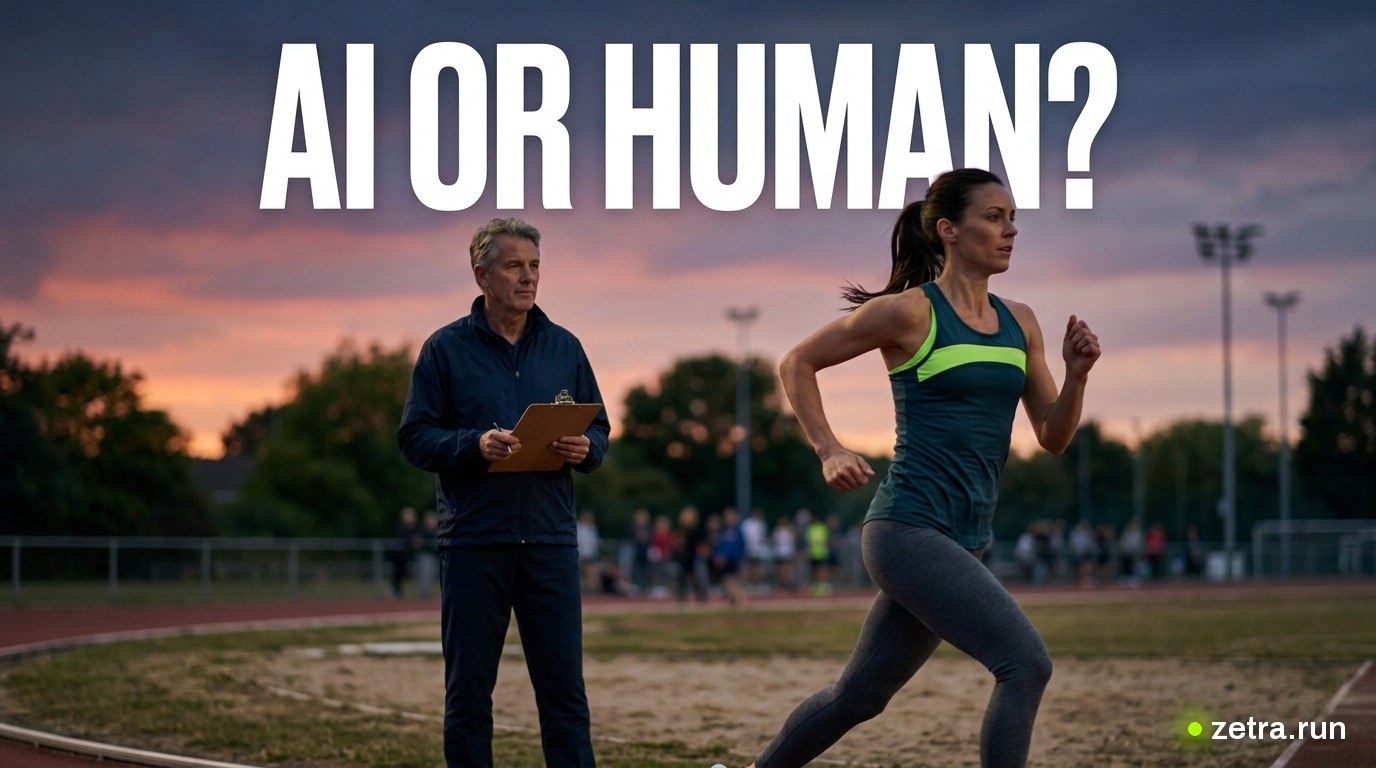
A human coach sees the hitch in your stride; an AI coach sees every heartbeat of every run you have ever done.
So which is better: an AI running coach or a human running coach? For most runners, the honest answer is this: AI coaching wins on access, cost, consistency, and live feedback during ordinary training. A good human coach still wins when your goal is complex, your body is sending unclear warning signs, or you need someone to watch how you move and make judgment calls beyond the data.
If you are deciding between hiring a coach and subscribing to an app, do not ask, “Which one is smarter?” Ask, “What kind of help do I actually need this season?”
You may need daily structure. You may need injury judgment. You may need someone in your ear when your heart rate climbs too fast. You may need a real person who knows your work stress, your race history, and the way you talk yourself out of hard workouts.
Different problem. Different coach.
Is an AI running coach vs human coach a fair comparison?
Yes, but only if you compare the job they are actually doing.
An AI running coach is usually best at turning your training data into day-to-day decisions. It can look at your pace, heart rate, cadence, recent runs, missed workouts, and effort ratings, then adjust what you do next. The better test is not whether the plan looks clever on day one. The better test is whether the plan changes when you change.
That is how reviewers increasingly judge these apps: you miss a session, rate a run as too hard, sleep badly, or show signs of fatigue. Does the plan respond? Or does it keep marching forward like nothing happened?
A human coach is different. A good coach is not only a plan writer. They are a second brain. They watch you run. They ask why your Tuesday session failed. They notice that your “easy pace” has become a pride project. They may hear the strain in your voice before your watch shows a problem.
That matters.
The mistake is treating AI coaching and human coaching as the same service delivered by different machines. They overlap, but they are not identical. AI is strongest where the signal is frequent and measurable. Human coaching is strongest where the signal is messy, emotional, visual, or medical.
If you want the basic concept first, read what is an AI running coach. If you are already sold on the category and just weighing value, read is an AI running coach worth it.
Where does a human running coach beat AI?
A human running coach beats AI when the problem needs eyes, judgment, and relationship.
Start with form. Your watch can estimate cadence. It can track pace changes. It can show that your heart rate spikes on hills. It cannot stand at the side of a track and see that your left hip drops late in a rep, or that your arm swing changes when you get tired.
Video can help. Sensors can help. But a skilled human watching you move still has an advantage.
Then there is injury judgment. An AI coach can respond to what you report. It can tell you to back off when pain persists. It can encourage rest when your training load looks too heavy. But it cannot physically assess you. It cannot palpate a tendon, test range of motion, or decide whether your shin pain is harmless soreness or something that needs urgent care.
Persistent pain, sharp pain, swelling, chest pain, dizziness, or symptoms that worry you need a qualified professional. Not an app. Not a motivational quote. Not another interval session.
Human coaches also win on complex race craft. If you are trying to finish your first 5K, an adaptive app may be enough. If you are chasing a difficult marathon PR, racing in heat, balancing tune-up races, managing travel, and trying to choose between several pacing strategies, a good human coach can add judgment that goes beyond the numbers.
Elite and highly complicated goals are different again. At that level, tiny details matter: training camps, strength work, biomechanics, nutrition timing, race selection, altitude, heat, team support, and recovery management. AI can support some of this. A good human coach remains ahead.
The last human advantage is accountability from a real relationship.
You may not need that. Some runners love training privately. But if you do better because a real person will ask how the workout went, that is not weakness. That is useful information. Human accountability works because you are not just following a plan. You are answering to someone who knows you.
Where does an AI running coach beat a human?
An AI running coach beats a human on availability, memory, consistency, and cost.
Your coach cannot be with you on every run unless you are a professional with an unusual setup. An app can. That changes the kind of feedback you get.
A traditional plan tells you what to do before the run: “Run 45 minutes easy.” A human coach may review it later and say you ran too hard. An AI coach can, depending on the product, respond while the run is happening. If your heart rate climbs early, it can tell you to ease off. If your cadence drops late, it can cue you. If your pace is drifting faster than the workout allows, it can catch the mistake before the damage is done.
That is not a small thing.
Most recreational runners do not fail because they lack a perfect 16-week plan. They fail because they make small bad decisions while tired: too fast on easy days, too hard after poor sleep, too much too soon after missed training. The 10% rule is often used as a rough guardrail for increasing volume, but real life is messier than any simple rule. You get sick. Work blows up. Weather changes. Your legs feel flat for no clear reason.
AI coaching is built for that kind of daily adjustment.
It also has perfect memory, at least within the data it can access. It does not forget your last six long runs. It does not confuse your threshold pace with another athlete’s. It can keep every session in view without needing you to send a weekly essay.
Cost matters too. One-to-one human running coaches commonly charge somewhere in the low hundreds of dollars per month. AI coaching subscriptions typically cost a small fraction of that. If the choice is between no coaching and affordable daily guidance, AI is not a downgrade. It may be the first coaching you can actually use.
Which coach wins by category?
Here is the practical comparison. No drama. Just what each option is usually better suited for.
| Dimension | Who usually wins? | Why |
|---|---|---|
| Form correction | Human coach | A person can watch your stride, posture, asymmetry, fatigue changes, and drills in real life. AI can infer some patterns from data, but it cannot fully see you move. |
| Cost | AI coach | Human one-to-one coaching commonly sits in the low hundreds of dollars per month. AI subscriptions are typically a small fraction of that. |
| Availability | AI coach | An app can be there before, during, and after ordinary runs. A human coach usually reviews sessions later and is limited by schedule. |
| Adaptation | Depends | AI can react quickly to missed runs, hard efforts, pace, heart rate, and cadence. A human can adapt around life context that never appears in the data. |
| Motivation | Depends | AI gives consistent prompts and removes guesswork. A human relationship can create deeper accountability for runners who need to be known, not just guided. |
| Injury judgment | Human professional | AI can suggest backing off and can flag caution from your reports. It cannot diagnose, physically assess, or replace a clinician. Persistent pain needs a professional. |
| Race craft | Human coach for complex goals | AI can guide pacing and workouts for many common goals. A skilled human is stronger for elite, unusual, or high-stakes race planning. |
How should you choose between an app and a coach?
Choose based on the failure point in your training.
If your biggest problem is consistency, you need a system that makes the next run obvious. AI coaching can be a strong fit because it removes the blank page. You open the app, see the workout, and run it. If the plan adapts after missed sessions or rough efforts, even better.
If your biggest problem is pacing, AI may help more than a human plan alone. You do not need to be told next Thursday that Monday was too hard. You need a cue while you are running too hard. This is where live coaching becomes different from a calendar.
If your biggest problem is recurring pain, hire help. A coach may be part of that, but a physiotherapist, sports doctor, or other qualified professional may need to assess you. Running through pain because an app says today is tempo day is bad training.
If your biggest problem is race execution, ask how complex the race really is. For a first 5K, first 10K, or general half marathon build, an adaptive plan may be enough. For a serious marathon goal with aggressive pacing, heat risk, fueling issues, tune-up races, and a history of injury, a human coach has a strong case.
If your biggest problem is that you do not trust yourself to be honest, think carefully. AI can be consistent, but it cannot always tell when you are hiding the truth from yourself. A good human coach may notice patterns in your words: every easy run becomes “steady,” every niggle becomes “fine,” every missed session becomes “busy week.”
That kind of reading is human.
Can the best answer be both AI and human coaching?
Yes. For many runners, the best model is app daily, human periodically.
Use AI for the work that happens every week: choosing the next session, adjusting after fatigue, keeping easy runs easy, guiding intervals, and reviewing patterns after each run. Then use a human coach, clinician, or in-person expert for the work that needs eyes and judgment: form review, injury questions, major race planning, and big-picture decisions.
This hybrid setup can be especially useful if you are improving but not elite. You may not need a human coach every week. You may need one at key moments: when you start a marathon block, when pain keeps returning, when your race goal changes, or when your training has gone flat for months.
It also keeps the relationship clean. The app handles repetition. The human handles nuance.
That matters because some coaching work is boring in the best way. “Slow down.” “Take the recovery.” “Do not race the easy run.” “You missed two sessions, so we are not forcing the long run.” AI can say these things every time without getting tired of you.
A human coach may be better saved for the conversations where the answer is not obvious.
What should you check before trusting any AI running coach?
Check whether the app changes when your training changes.
A plan generator that gives you 12 weeks of workouts and never adapts is not really coaching. It may still be useful. Couch to 5K-style plans help many beginners because the structure is simple and the goal is clear. But calling a static plan “AI coaching” does not make it responsive.
Look for these signs:
- It uses your actual runs. Pace, heart rate, cadence, completed workouts, and missed sessions should matter.
- It asks about effort. Data is useful, but how the run felt still counts.
- It adjusts before the next run. If you are tired, missed training, or overreached, the next session should not pretend nothing happened.
- It explains the change. You should know why today is easier, shorter, or harder.
- It avoids false certainty. Good coaching admits limits. Any app that acts like it can diagnose injury from watch data alone is overreaching.
Also check the coaching style. Some runners need calm restraint. Some need direct cues. Some want detailed numbers. Some want simple instructions. The best app for you is the one that helps you make better decisions while you are actually running.
Frequently asked questions
Is an AI coach as good as a human coach?
For everyday training, an AI coach can be as useful as a human coach for many runners, especially if you need structure, adaptation, and feedback during runs. A good human coach is still better for form correction, injury judgment, complex race strategy, and reading life context that does not show up in your data.
What can a human running coach do that AI cannot?
A human running coach can watch you move in person, notice subtle form changes, ask deeper follow-up questions, and make judgment calls from context. They can also build accountability through a real relationship. AI can respond to data and your reports, but it cannot physically assess an injury or replace a physiotherapist or doctor.
Is AI coaching cheaper than a running coach?
Typically, yes. One-to-one human running coaches commonly cost somewhere in the low hundreds of dollars per month, while AI coaching subscriptions usually cost a small fraction of that. Price should not be the only factor, but it matters if coaching would otherwise be out of reach.
Can I use both?
Yes. A strong setup is to use an AI coach for daily guidance and a human coach or professional for periodic review. The app can manage routine adjustments, pacing cues, and session memory. The human can help with form, injuries, complicated goals, and big decisions.
Who should hire a human coach?
Hire a human coach if you have an ambitious or complicated race goal, recurring injury concerns, a history of overtraining, or a need for real relationship-based accountability. Elite runners and runners chasing highly specific goals are usually better served by a good human coach, even if they also use technology.
If you want coaching that reacts during the run rather than only after it, Zetra is built for that: live voice cues through your headphones, using heart rate, pace, and cadence from Apple Watch with an iPhone companion app. A human coach may still be the right call for complex goals or injury questions. For the ordinary decisions that make or break most training weeks, live guidance can remove a lot of guesswork.
Run with a coach in your ear.
Zetra guides you live — heart rate, pace and cadence — on every run.