Can an App Actually Motivate You to Run?
By the Zetra Coaching Team
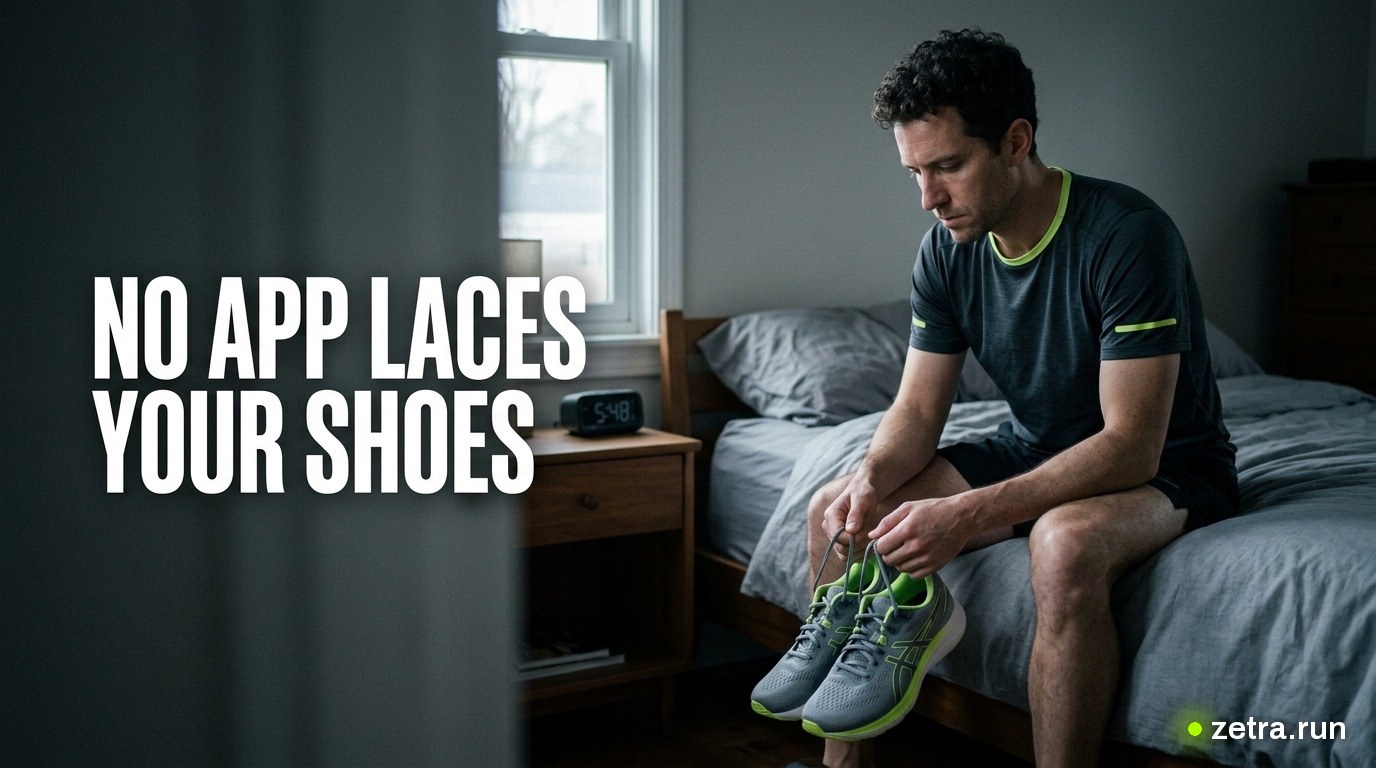
No app has ever made anyone lace up; the good ones just remove the reasons not to.
So can an app actually motivate you to run? Not by injecting willpower into your brain at 6:30 a.m. Software cannot want the run for you. What it can do is change the moment before the run: make the next step obvious, make the workout small enough to start, remove planning decisions, and give you feedback during the run so the effort feels purposeful instead of random punishment.
That is the honest answer.
If you have downloaded five running apps and still do not go out, you are not broken. You may be using tools that treat motivation like a notification problem. It usually is not. Most of the time, quitting starts earlier: the plan is too vague, the run is too hard, the app makes you feel behind, or the whole thing depends on a mood that does not reliably arrive.
Why does another running app not make you go out?
Another running app does not make you go out because motivation is a weak trigger when the next action still feels heavy.
You know this already. You open the app. You see a plan. Maybe there is a streak, a badge, a chart, or a reminder. Then your brain starts negotiating.
Is this the right workout? Do I have enough time? What if I feel awful again? Should I run faster than last time? Am I already too far behind?
That little pile of decisions is friction. Friction is what sits between “I should run” and “I am outside.”
A good running app does not solve motivation by yelling louder. It reduces the number of decisions you have to make before your shoes are on.
The best version sounds boring:
- Here is today’s run.
- Here is how easy it should feel.
- Here is when to walk.
- Here is when to stop.
- If yesterday went badly, here is the adjusted version.
That works better than hype because it meets the real problem. You do not need a speech. You need a next step that feels possible.
This is why systems beat moods. If you want the deeper version of that idea, read motivation is overrated. The short version: motivation is useful when it appears, but it is too unreliable to be the thing your running habit depends on.
What can a running app genuinely change?
A running app can change the conditions around the decision to run. It cannot make the decision for you.
That sounds like a small distinction. It is the whole game.
Here is what software can and cannot do honestly:
| Motivation failure | What software can genuinely change | What it cannot change |
|---|---|---|
| “I do not know what to do today.” | Give you one clear workout based on your current plan. | Decide that you value the goal. |
| “The run feels too big.” | Shrink the task: run-walk, short duration, easier pace, simpler instructions. | Remove every bit of discomfort from starting. |
| “I always go out too hard.” | Cue pace, effort, heart rate, or walk breaks while you run. | Physically slow your legs down for you. |
| “I feel like I am failing.” | Adjust the plan after missed or hard sessions so you are not trapped by the old schedule. | Make comparison feel good if the app keeps showing you other people’s highlight reels. |
| “Running alone feels empty.” | Add audio guidance, structure, and a sense of presence. | Replace real human connection if that is what you need most. |
| “Something hurts.” | Tell you to stop, back off, or avoid pushing through. | Diagnose an injury or replace a doctor, physiotherapist, or in-person assessment. |
That last row matters.
AI coaching can be useful. It can react to data, adapt plans, and give you cues at the exact moment you usually drift. But it cannot watch your form in person. It cannot put hands on a sore tendon and assess it. It cannot replace a physiotherapist or doctor. And if you are chasing elite performance, managing a complex injury history, or balancing a very demanding race calendar, a good human coach is still ahead.
Honest tools have limits. That is part of why you can trust them.
Why do running apps sometimes make motivation worse?
Running apps make motivation worse when they turn running into a debt you are always behind on.
This happens quietly.
You miss Monday. The plan does not adapt. You miss Wednesday. The streak breaks. You open the app on Friday and it shows you the workout you “should” have done three days ago.
Now the app is not helping you run. It is keeping score against you.
Streaks can work for some people, especially when the target is gentle. A ten-minute walk-run counts. A mobility day counts. A true rest day is not treated like failure. But streaks become risky when they reward obedience over judgment.
Your body does not care about a badge.
If you are tired, sick, sore, under-slept, or overloaded from life, pushing through to protect a streak can teach the wrong lesson: that consistency means ignoring signals. It does not. Consistency means returning without drama.
Comparison feeds can cause the same problem. You planned an easy 25 minutes. Someone else posts a fast 10K. Suddenly your useful run feels small. You speed up. The run feels awful. Next time, you avoid it.
That is not a character flaw. That is bad environment design.
A good app should make the right action feel easier. Not louder. Not more public. Easier.
What actually helps you stick with running?
You stick with running when the next run is clear, achievable, and not miserable every time.
That is the plain version of behavior design.
There are four pieces that matter for most runners.
Reduce friction before the run
You are more likely to run when the decision is already made.
Not in a dramatic way. Just enough.
Set the clothes out. Pick the route. Know the first five minutes. Make the workout visible before the day gets noisy.
An app can help here if it removes planning friction. It should tell you what to do today, not ask you to become a coach before breakfast.
Better still, it should adapt. Reviewers increasingly test AI coaching apps by asking a simple question: does the plan actually change when the runner changes? If you miss sessions, rate a run as hard, sleep badly, or carry fatigue, a useful plan should not pretend nothing happened.
Static plans can work. Couch to 5K plans work for many beginners because they make the next action simple. But if life interrupts, a rigid plan can become another reason to quit.
Make the next action small enough
A run that feels too big does not need more motivation. It needs resizing.
If you keep quitting, your next run may need to be almost embarrassingly easy:
- 10 minutes total.
- Run 30 seconds, walk 90 seconds.
- Stop while you still feel like you could do more.
- Repeat that until starting feels normal.
This is not weakness. It is how you teach your brain that running is safe to repeat.
Many people try to restart with the version of themselves they remember. The old 5K pace. The old route. The old watch stats. That version may come back, but you do not get there by punishing the current one.
Build identity without pretending
Identity helps when it is believable.
“I am a runner” may feel fake if you have run twice this month. Fine. Use a smaller identity.
“I am someone who goes outside for ten minutes.” “I am someone who starts easy.” “I am someone who keeps promises small.”
That counts.
Apps can support this by showing completion, patterns, and progress without turning every run into a public performance. The goal is not to convince the world you run. The goal is to make running feel like something you do.
Make the run feel better while it is happening
This is where a lot of motivation advice misses the point.
If running feels awful every time, the fix is usually pace, not motivation.
You are not failing because you lack grit. You may simply be running too fast for your current fitness. Your breathing gets ragged. Your legs burn. Your brain records the whole thing as a threat. Then, when the next run appears, of course you resist.
Easy running should feel controlled. You should be able to speak in short sentences. If you use heart rate, easy usually means you are not chasing high numbers. If you use effort, think relaxed and repeatable.
The common 80/20 idea says many runners do best when most running is easy and a smaller amount is harder. The exact split is not magic for every person, but the principle is useful: if every run becomes a test, you will not want to take it again tomorrow.
If you are unsure how slow easy should feel, read easy run pace. For many runners, the answer is slower than pride wants and faster progress than punishment gives.
Can in-run feedback make effort feel less punishing?
In-run feedback can help because it gives effort a job.
Without feedback, a beginner run can feel like chaos. Your breathing jumps. Your pace changes without you noticing. A hill appears. You panic. You assume the whole run is going badly.
A good cue interrupts that spiral.
Slow down. Shorten the stride. Walk now, before you are wrecked. You are on pace. This is supposed to feel easy. Hold this effort for two more minutes.
That kind of guidance can make the run feel more purposeful. Not easier in the fake sense. More understandable.
Audio matters here because you do not have to keep checking your watch. When you are new, returning, or anxious about pace, looking down every 20 seconds can make the run feel like an exam. A voice cue can be simpler: do this now.
This is where app categories differ.
A plan generator can tell you what to do before the run. An audio interval app can tell you when to run and walk. An AI coaching app can, in theory, respond to what is happening in the session, such as pace, heart rate, and cadence, then cue you while you are still able to adjust.
That does not make it magic. The cue still has to be useful. The plan still has to fit. And you still have to step outside.
But for runners who hate feeling alone with the effort, a voice can change the emotional texture of the run. It adds presence. It makes the next minute less vague.
How should you choose a running app if motivation is the problem?
Choose the app that makes tomorrow’s run easier to start and easier to finish at the right effort.
Do not choose based on the loudest streak system. Do not choose the app that makes you feel guilty before you have built a habit. Do not choose the one that gives you a 12-week plan and then acts shocked when real life happens.
Use this test instead:
- Does it tell you exactly what to do next?
- Does the first workout feel almost too manageable?
- Does it adapt when you miss a run or struggle?
- Does it teach easy effort clearly?
- Does it reduce watch-checking during the run?
- Does it make you feel guided, not judged?
- Does it tell you to back off when pain or fatigue is the smarter signal?
Cost also matters. One-to-one human running coaches commonly charge somewhere in the low hundreds of dollars per month. AI coaching subscriptions typically cost a small fraction of that. That can make app-based coaching more accessible.
But cheaper is not the same as better for every runner.
If you need accountability from a real person, get the real person if you can. If you have persistent pain, see a professional. If your goal is complex, elite, or tied to a history of injury, a human coach may be the better choice.
If your main problem is that you never know what to do, start too hard, feel alone, and quit because running feels bad, a well-designed app can help.
Not by motivating you.
By removing the reasons you keep deciding not to start.
Frequently asked questions
Do running apps actually help motivation?
Running apps can help motivation if they reduce friction, make the next run clear, and guide your effort while you run. They do not create motivation from nothing. The best apps help you start before you overthink it and help you keep the run easy enough to repeat.
Why do I keep quitting running?
You may keep quitting because your runs are too hard, too vague, or too dependent on feeling motivated first. Many runners restart too fast, compare themselves to old fitness, then learn to dread the next run. Make the next action smaller and slow the pace down.
Are streaks good for motivation?
Streaks can help when they reward realistic consistency. They can hurt when they make rest, illness, fatigue, or pain feel like failure. A good streak system should support returning to running, not push you to ignore your body.
Does having a coach voice help?
A coach voice can help if it gives timely, specific cues during the run. It can make running alone feel less empty and reduce the need to stare at your watch. It works best when the guidance responds to your actual effort, not just a timer.
What if I hate running?
If you hate running because every run feels like gasping and surviving, slow down and use walk breaks. The fix is often pace, not motivation. If you hate running because of persistent pain, stop pushing through it and see a professional. If you simply prefer another form of movement, that is allowed too.
If the hard part is knowing what to do, keeping the run easy, and hearing the right cue while you are out there, Zetra is built for that: live voice coaching during the run, with a plan that adapts before each session and analysis after. The app cannot lace up for you. It can make the next run much harder to talk yourself out of.
Run with a coach in your ear.
Zetra guides you live — heart rate, pace and cadence — on every run.