How to Pace Yourself So You Don't Blow Up Mid-Run
By the Zetra Coaching Team
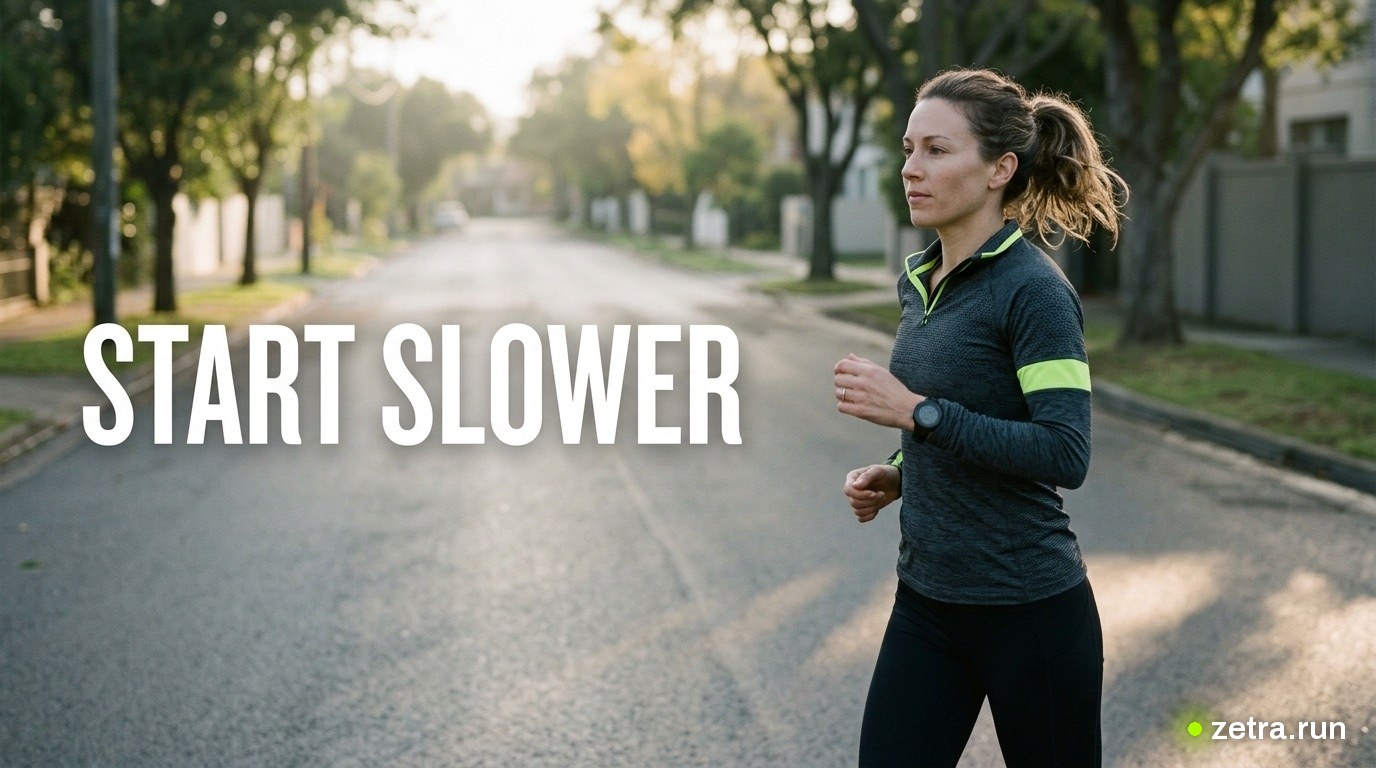
You do not blow up mid-run because you are weak; you blow up because the first mile lied.
To pace yourself running, start the first 5 to 10 minutes slower than you think you should, use the talk test before you trust your watch, and aim to finish feeling steadier than you started. Your opening pace should feel almost too easy. If you are breathing hard in the first few minutes, you are not “settling in.” You are borrowing energy from the middle of the run.
The fix is simple, not easy: hold back early, run by effort, and let pace come to you later. Your job is to make the first kilometre boring.
Why do I start too fast when running?
You start too fast because the beginning of a run feels easier than it really is.
Your legs are fresh. Your brain is excited. You finally got out the door. If you are running with other people, you may also match their rhythm without noticing. The first few minutes give you bad information.
Your body is still catching up.
When you begin running, your muscles ask for more oxygen and fuel right away. Your breathing, heart rate, blood flow, and cooling system take a few minutes to rise to the job. That delay is normal. During that gap, you can run faster than your sustainable effort because you are using freshness, stored tension, and adrenaline.
Then the bill arrives.
Your breathing gets sharp. Your stride gets heavy. The pace that felt smooth at minute three feels stupid at minute eighteen. You look at your watch and wonder how the same pace can feel so different.
That is the first mile lie: early pace feels cheap before your body has priced it correctly.
Beginners get caught by this more often because you do not yet have a strong internal speedometer. You know “running” and “not running.” You may not yet know the difference between easy, steady, hard, and too hard until it is too late.
That skill is trainable.
What does blowing up mid-run actually mean?
Blowing up means your chosen effort is higher than what you can hold for the run you planned.
It is not one single thing. It can feel like your lungs failing, your legs filling with concrete, your heart rate climbing and refusing to settle, or your brain suddenly bargaining for walk breaks. The common thread is this: the pace you picked early does not match your current fitness, terrain, weather, recovery, or distance.
Sometimes you have run out of patience, not energy. You started tense, fought the pace, and made the run mentally expensive.
Sometimes you have crossed from easy running into a harder zone without meaning to. Easy running should feel controlled. You can speak in full sentences. Your breathing is present but not panicked. When you go too hard, your breathing becomes the boss. You can still keep moving for a while, but you are no longer building the run. You are surviving it.
There is also a simple fuel angle on longer runs. If you are running long enough, starting too fast burns through available energy sooner and makes the later miles feel worse. But for many beginners, the mid-run collapse happens before fueling is the main issue. The opening effort was just too high.
Do not treat blowing up as a character flaw.
Treat it as data.
How slow should the first mile be?
Your first mile should feel controlled enough that you could go faster, and you choose not to.
For beginners, the best first-mile rule is this: start at an effort that feels almost embarrassingly easy. If you are wondering whether you are going too slow, you are probably close. If you are proud of the pace in the first three minutes, you are probably in trouble.
Use this first-kilometre discipline:
- Start with shorter steps. Do not reach forward. Keep your stride compact.
- Let your breathing stay quiet. You should be able to speak a full sentence.
- Ignore your average pace early. GPS pace jumps around, especially near trees, buildings, and turns.
- Wait before judging the run. Give your body 8 to 10 minutes to settle.
- Only then decide whether to build.
Think of the first kilometre as a warm-up you are allowed to count.
If you finish the first kilometre annoyed that it was too easy, good. That is the point. You can spend that saved energy later. You cannot get it back once you have burned it.
This does not mean every run has to be slow forever. It means your fast running goes better when your easy running is honest. If you are not sure what honest easy pace feels like, start with this guide to easy run pace.
What is the best way to pace yourself running?
The best pacing tool for beginners is feel, checked with the talk test. Heart rate can help. Watch pace comes last.
That may feel backwards. Pace is clear. Pace gives you a number. But for a beginner, pace can lie almost as much as the first mile does.
A 10:30 mile on a cool flat path might be easy. The same 10:30 mile uphill, into wind, after poor sleep, might be too hard. Your watch shows the same number. Your body pays a different price.
Use tools in this order.
| Pacing tool | Strength | Weakness |
|---|---|---|
| Feel and talk test | Works anywhere, teaches you control, adjusts naturally to hills and weather | Takes practice and can be fooled by excitement early |
| Heart rate | Shows internal effort and can warn you when you are drifting too hard | Lags behind effort, varies with heat, stress, caffeine, sleep, and watch accuracy |
| Watch pace | Simple, measurable, useful on flat steady routes | Can push beginners too hard, changes with terrain, and may jump around in real time |
Here is the beginner version.
Feel first. Ask, “Could I keep this going for longer than planned?” If the answer is no in the first half of the run, slow down.
Talk test second. On easy runs, you should be able to speak in full sentences. Not a speech. Just normal phrases without gasping. If you can only say two or three words, you are running too hard for an easy run.
Heart rate third. Heart rate is useful, but it is not instant. Your heart rate may still be climbing after you have already changed pace. It can also run higher in heat, stress, or poor recovery. Use it as a guardrail, not a steering wheel.
Pace last. Pace is best used after the run, or during specific workouts once you have more experience. For now, your watch pace is a clue. Your breathing is the evidence.
How do I practise not starting too fast?
Practise negative-split easy runs.
A negative split means the second half of your run is faster than the first half. For beginners, this does not mean sprinting home. It means the run gets slightly stronger, not dramatically harder.
Start with a 20 to 30 minute easy run:
- First 10 minutes: very easy, almost too slow.
- Middle 10 minutes: comfortable, full sentences still possible.
- Last 5 to 10 minutes: a little smoother if you feel good, never forced.
If you use distance instead of time:
- First kilometre: controlled and boring.
- Middle section: relaxed.
- Final kilometre: steady, only faster if your breathing stays calm.
The win is not the faster finish. The win is control.
You are teaching your body and brain a new pattern: do not spend everything early. Let the run open. Let the pace come to you.
This skill matters later if you race a 5K, 10K, half marathon, or marathon. Most runners do better when they avoid panic at the start and pass people late. But you do not need to be racing to use the idea. Negative splitting an easy run is one of the cleanest ways to learn pacing without turning every run into a test.
If you want the full concept, read this guide to negative splits.
How should I pace hills, wind, and hot days?
Pace hills, wind, and heat by effort, not by the number on your watch.
This is where beginners get trapped. You are running along at a comfortable pace. Then the road tilts up, the wind hits your chest, or the sun starts cooking the path. Your watch says you have slowed down. You panic and push.
Now the effort spikes.
That is how a normal route becomes a blow-up.
On hills, shorten your stride and keep your effort steady. Let pace slow. You are not losing fitness by running slower uphill. You are respecting the cost of the climb. If your breathing jumps, you are working too hard.
Into wind, do the same. Relax your shoulders. Keep your cadence natural. Do not fight for your flat-road pace. Wind makes pace more expensive.
On hot or humid days, expect easy pace to be slower. Your body is cooling you while moving you. That costs energy. If you chase your usual pace, your heart rate and breathing may climb even when your route looks easy on paper.
The rule is simple: conditions change pace, but they should not hijack effort.
Your watch is allowed to show slower numbers. You are still doing the work.
What should I do when I realise I went out too fast?
Slow down earlier than your ego wants.
The mistake is waiting until you are desperate. If you notice your breathing getting ragged, your shoulders tightening, or your thoughts turning negative in the first half of the run, respond now.
Use a reset:
- Slow to a shuffle for one minute. Keep moving, but take the pressure off.
- Drop your shoulders and unclench your hands. Tension wastes energy.
- Breathe low and easy. Do not force a special pattern. Just calm it down.
- Restart at a pace that feels too slow. Not the pace you wish you could run.
- Check again after five minutes.
If you need to walk, walk before the run collapses. A planned 60-second walk can save the session. A desperate walk after you have buried yourself feels worse and teaches you less.
This is not failure. It is pacing practice.
Over time, you want to catch the mistake sooner. First you notice it after you blow up. Then you notice it halfway through. Then you notice it in minute five. Eventually you catch it before it happens.
That is progress.
Frequently asked questions
Why do I run out of energy halfway?
You usually run out of energy halfway because the first part of the run was too hard for the distance you planned. Fresh legs and early excitement make the pace feel easier than it really is. Start slower, keep your breathing under control, and save the stronger effort for the second half.
How do I know if I'm going too fast?
You are probably going too fast if you cannot speak in full sentences during an easy run, your breathing feels sharp early, or you are already thinking about stopping before halfway. Slow down before you need to. The right early pace often feels almost too easy.
Should I pace by heart rate or feel?
Start with feel and the talk test, then use heart rate as a backup. Heart rate can be helpful, but it lags and changes with heat, stress, sleep, caffeine, and watch accuracy. For beginners, breathing and control are more useful in the moment than chasing a perfect number.
Why is my first mile always fastest?
Your first mile is often fastest because you start fresh, excited, and not fully aware of the effort yet. Your aerobic system has not caught up, so the pace feels cheaper than it is. Make the first mile deliberately slower and give your body time to settle.
How do I stop starting too fast?
Use a first-kilometre rule: run the opening 5 to 10 minutes at a pace that feels almost too slow. Ignore average pace early, keep your steps short, and use the talk test. If you can finish the run slightly stronger than you started, you paced it well.
Pacing is a skill, not a personality trait. You learn it by holding back when the run feels easy, adjusting when terrain changes, and finishing with control instead of damage. If you want live help during the run, Zetra reacts to your heart rate, pace, and cadence in real time so you know when to ease off before the first mile lies to you.
Run with a coach in your ear.
Zetra guides you live — heart rate, pace and cadence — on every run.