Running in the Heat: Pace, Hydration, and Honest Limits
By the Zetra Coaching Team
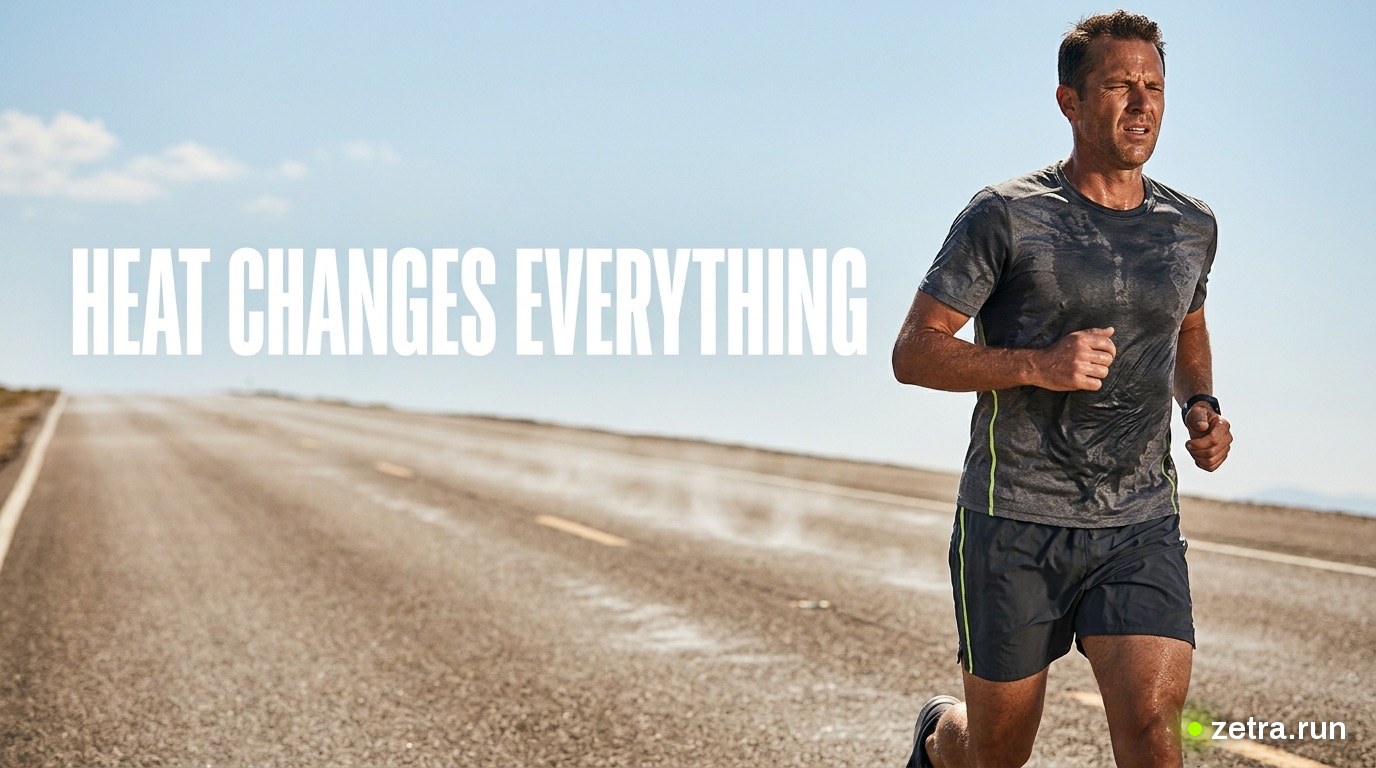
Heat does not make you weak, it makes the same pace cost more.
When you run in hot weather, slow down and run by effort, not by the pace you wish the watch showed. Heat pushes your heart rate up because your body has to cool you while it also powers your legs. That means a pace that felt easy in spring can feel like a workout in July. The fix is not toughness. The fix is adjusting pace, timing, route, clothing, and hydration so the run matches the conditions.
Your goal in summer is simple: finish the run with control. Some days that means slower miles. Some days it means shorter intervals. Some days it means stopping.
That is training. Not failure.
Why is running so much harder in hot weather?
Running feels harder in hot weather because your body is doing two jobs at once: moving you forward and moving heat away from your core.
In cool weather, more of your blood can support the working muscles. Your heart pumps oxygen-rich blood to your legs, your breathing rises, and your effort climbs in a fairly predictable way.
In heat, the system changes. Your body sends more blood toward the skin so sweat can evaporate and carry heat away. That cooling process is useful, but it competes with running. Less blood is available for the exact same pace. Your heart has to beat faster to keep up.
That is why your heart rate can be higher at the same pace.
You are not imagining it. Your normal easy pace can feel ragged. Your legs may feel flat. Your breathing can go from calm to noisy sooner than expected. If you track heart rate zones, you may see a run that should be Zone 2 drift upward even when the pace stays steady.
Heat also raises perceived effort, which is the simple question: “How hard does this feel right now?” In summer, the answer changes fast. A pace that felt like a 3 out of 10 can become a 6 out of 10 after the sun hits your back, the breeze disappears, or the road starts radiating heat.
Humidity makes this worse. Sweat cools you when it evaporates. In humid air, sweat sits on your skin longer. You are losing fluid, but getting less cooling from it.
That is the trap.
You see the pace. You judge yourself. You try to hold it. Your heart rate climbs. Your form tightens. The run becomes a fight you did not need to pick.
Summer running asks for a different standard: same effort, slower pace.
How should I adjust pace when running in the heat?
You should adjust pace by effort first, heart rate second, and watch pace last.
Pace is an output. In heat, it is the least honest number on your screen. It tells you how fast you are moving, but not what that speed is costing your body today.
Start with effort:
- Easy means you can speak in short sentences.
- Steady means you can speak in phrases.
- Hard means you do not want to talk.
- Too hard means your breathing feels panicked or your head feels off.
For most summer easy runs, stay in the first bucket. If you are using the run to build endurance, the purpose is time on feet without digging a hole. Your watch pace can be slower than usual and the run can still be exactly right.
If you use heart rate, give it more respect than pace. A heart rate that climbs steadily while pace stays the same is a sign the heat is adding cost. That does not always mean danger, but it does mean you should respond. Slow down. Take a short walk break. Move into shade. Cut the route if the run is no longer under control.
This is especially true for easy days. Your easy run pace is not a fixed number. It is the pace that lets you keep the effort easy today. In summer, that number often gets slower.
For workouts, adjust the session before you start. Do not wait until you are cooked.
Try these swaps:
- Change continuous tempo to shorter repeats with recovery.
- Run by effort instead of target pace.
- Move the workout to early morning or evening.
- Shorten the total hard running.
- Use shaded loops so you can stop safely if needed.
If your plan says “6 miles easy” and the day is hot, you can make that “45 minutes easy,” or “30 minutes easy plus walk breaks,” and keep the training goal intact. The body adapts to the work you can recover from. It does not give bonus points for forcing a pace in bad conditions.
What should I do when the heat starts changing the run?
You need a plan before the run, then a decision rule during the run. Heat can turn slowly or suddenly. The right response depends on what you feel.
Use this as your on-run checklist:
| Heat signal | What to do |
|---|---|
| Pace feels normal but heart rate is higher than usual | Slow slightly and run by effort. Let the pace go. |
| Breathing gets ragged on an easy run | Back off until you can speak again, or add a walk break. |
| You stop sweating, feel chilled, or get goosebumps in the heat | Stop running, get out of the sun, cool down, and get medical help. |
| You feel dizzy, confused, unusually weak, or unsteady | Stop immediately and get medical help. Do not try to “run it off.” |
| Headache, nausea, or cramps are building | Stop or shorten the run. Move to shade, cool down, and reassess. |
| The route has no shade, water, or safe exit | Change the route before you start. Heat removes your margin for error. |
The key is not panic. The key is early action.
Small adjustments early save the run. Big adjustments late often mean you waited too long.
If you feel normal but the effort is creeping up, slow down. If you feel strange, stop. Strange means symptoms that do not match normal running discomfort: chills in the heat, confusion, dizziness, stopping sweating, stumbling, or feeling like your body is no longer responding cleanly.
Those are not training signals. Those are stop signals.
Heat illness can become serious. If you have warning signs, stop running, get to a cooler place, and get medical help.
How long does it take to get used to running in the heat?
Heat acclimatization takes repeated exposure over days to weeks. You cannot force it in one heroic run.
Your body can adapt to hot conditions. You may start sweating sooner. The same effort may feel less shocking. Your heart rate may settle better than it did on the first hot day. But adaptation comes from controlled, repeated runs, not from proving a point.
The mistake is treating the first hot week like normal training. You look at the calendar and assume your fitness has disappeared. It has not. Your environment changed.
For the first stretch of hot weather, lower the demands:
- Keep easy runs truly easy.
- Shorten hard sessions or replace them with strides.
- Add walk breaks before you need them.
- Avoid stacking heat stress on top of poor sleep, travel, or heavy life stress.
- Be careful with long runs until you know how your body responds.
If you are returning from time off or just starting out, be even more conservative. Beginners often run too fast on cool days already. Heat makes that mistake louder. A run-walk approach can be the smartest way to keep effort under control.
Acclimatization is also specific. If you train only in cool mornings, a midday race in heat can still hit hard. That does not mean you should train in dangerous conditions. It means you should respect the gap between your training environment and the event environment.
You can include gentle heat exposure when it is safe, but do not confuse exposure with punishment. The dose should be small enough that you recover.
How should I hydrate for running in hot weather?
Drink to thirst, then use context.
For short, easy runs, many runners do fine by drinking when thirsty and starting the run normally hydrated. You do not need to force large amounts of water before every summer jog.
But context matters. The hotter it is, the longer you run, the more you sweat, and the less access you have to fluids, the more you need to plan. If you are going long, running hard, or heading into exposed heat, carry fluid or choose a route with water access.
Your goal is not to finish heavier with a stomach full of water. Overdrinking can be dangerous, especially if you take in large amounts of plain water over a long effort. The body needs fluid balance, not endless fluid.
Sodium can help during long or very hot efforts, especially if you are a salty sweater, your clothes dry with white marks, or you are out for a long time. You do not need to make it complicated. A sports drink, electrolyte mix, or salty food before or after can be enough for many runners. The right approach depends on your sweat rate, duration, conditions, and stomach tolerance.
A simple hydration check is how you feel before the run:
- Are you already thirsty?
- Is your mouth dry?
- Did you drink normally today?
- Are you heading somewhere with no water?
- Is the run long enough that thirst could become a problem?
Answer honestly. Plan from there.
Do not use thirst as an excuse to ignore obvious heat risk. Also do not use hydration as a shield against heat. Drinking more does not make a dangerous route safe. Water helps. Shade, timing, and intensity matter too.
What are the best hot weather running tips before you start?
Set the run up so you do not need to be brave.
Run early or late when you can. The sun matters. Air temperature is only part of the stress. Direct sun, dark pavement, no wind, and humidity can make a normal route feel completely different.
Choose shade over perfect distance. A boring shaded loop beats a scenic exposed route on a bad heat day. Loops also give you options. You can stop at your car, refill water, change the plan, or call it.
Wear light, breathable clothing. Pick a hat or visor if it helps keep sun off your face. Sunglasses can reduce squinting and tension. Sunscreen matters on exposed runs. Avoid overdressing to “sweat more.” Sweating more is not better training. It is just more heat and fluid stress.
Adjust the workout before your ego gets a vote.
If the plan says intervals, ask what the session is meant to train. Speed? Controlled discomfort? Race rhythm? You can often keep the purpose while changing the exact pace. Shorter reps, longer recoveries, shaded terrain, or effort-based targets are all valid.
Tell someone where you are going if the conditions are rough. Carry your phone if the route is isolated. Start with an exit plan.
And if the day is extreme, move the run indoors or skip it. One missed run does less harm than one bad heat decision.
Frequently asked questions
Why is running so much harder in the heat?
Running is harder in the heat because your body sends more blood to your skin for cooling while your muscles still need blood for movement. Your heart rate rises, your breathing feels harder, and the same pace costs more effort than it would in cooler weather.
How much slower should I run in hot weather?
Run as much slower as needed to keep the intended effort. There is no honest universal pace adjustment because heat, humidity, sun exposure, fitness, sleep, and acclimatization all change the cost. For easy runs, use the talk test: if you cannot speak in short sentences, slow down or walk.
How long does heat acclimatization take?
Heat acclimatization usually takes repeated exposure over days to weeks. You may feel better after several safe, controlled runs in warm conditions, but you cannot force the process in one hard session. Keep the early hot-weather runs easier than usual.
How much should I drink when running in heat?
Drink to thirst, then adjust for the run. Longer, hotter, harder, and more exposed runs need more planning than short easy runs. Carry fluid or choose water-access routes when needed. For long or very hot efforts, sodium can help. Avoid forcing excessive plain water, because overdrinking can be dangerous.
What are the signs of heat illness?
Warning signs include dizziness, confusion, chills or goosebumps in the heat, stopping sweating, unusual weakness, stumbling, headache, nausea, or feeling mentally off. Stop running, get out of the sun, cool down, and get medical help if symptoms are serious or do not quickly improve.
Heat changes the cost of the run. Respect that, and summer training becomes much simpler: run by effort, slow down early, plan your route, and stop when your body gives you a real warning. If you want those adjustments made live while you run, Zetra listens to your heart rate, pace, and cadence, then coaches you in the moment.
Run with a coach in your ear.
Zetra guides you live — heart rate, pace and cadence — on every run.