Running Shoes: What You Need and What to Ignore
By the Zetra Coaching Team
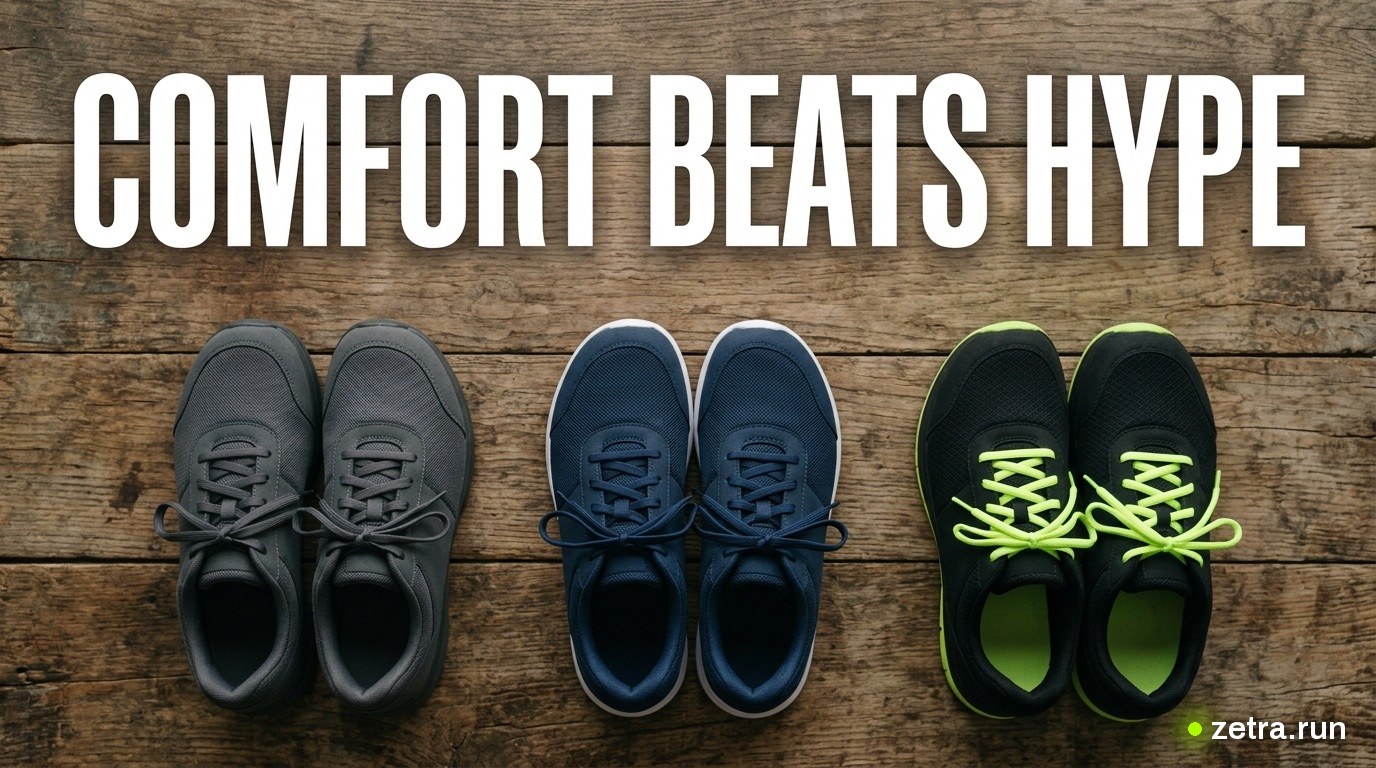
Your first running shoes should solve comfort, not prove you are serious.
If you are a beginner, the best running shoes are the ones that fit well, feel comfortable when you run, and do not create hot spots, rubbing, numbness, or pain. You do not need carbon plates. You do not need the most expensive shoe on the wall. You may not need “stability” shoes, even if you have flat feet. Start with comfort, a proper fit, and a short test run. Ignore anything that tries to diagnose your whole future from a 30-second look at your feet.
Shoe marketing makes this feel harder than it is. Neutral. Stability. Motion control. Max cushion. Super foam. Daily trainer. Race day shoe. Suddenly you are not buying shoes. You are trying to pass an exam.
You do not need to pass an exam.
You need a pair of shoes that lets you run tomorrow without thinking about your feet the whole time.
What should beginner running shoes actually do?
Beginner running shoes should protect your feet from the ground, feel stable enough for your stride, and disappear once you start running.
That last part matters. A good beginner shoe is not the one that feels exciting in the shop for ten seconds. It is the one you stop noticing after five minutes of easy running.
For most beginners, the safest starting point is a comfortable daily trainer. That means:
- Enough cushioning that the ground does not feel harsh
- A secure heel that does not slip
- Space for your toes to spread a little
- No rubbing on the arch, toes, heel, or outside of the foot
- A ride that feels natural, not wobbly or forced
- A price you can afford without treating the shoe like a sacred object
Running shoes do not prevent every injury. No shoe can do that. Most beginner problems come from doing too much too soon, running every run too hard, or ignoring early warning signs. If you are worried about that side of training, read why runners get injured. Shoes matter, but they are only one part of the picture.
Your first pair should make it easier to build the habit. If you are starting with a couch to 5k style plan, you need a shoe that handles short run-walk sessions and easy miles. You do not need a race shoe built for someone chasing seconds.
How should running shoes fit?
Running shoes should fit with a thumb-width of space in front of your longest toe, a secure midfoot, and no pressure points when you jog.
Do not buy them like dress shoes. Your feet move when you run. They swell a little. Your toes need room. If your toes touch the front while standing, the shoe is probably too small for running.
Use this fit check:
- Try shoes later in the day if you can. Your feet may be slightly larger then.
- Wear the socks you plan to run in. Thick socks change the fit.
- Stand up and check toe room. Aim for about a thumb-width in front of your longest toe.
- Check width, not just length. Your toes should not feel squeezed together.
- Lace them properly. A shoe that feels loose may just need better lacing.
- Jog if the shop allows it. A shoe that feels fine walking can rub when running.
- Trust pressure and rubbing. “It will break in” is a risky bet.
The shoe should hold your heel without digging into your Achilles. Your midfoot should feel secure, but not strangled. Your toes should have room without sliding around.
If one foot is larger, fit the larger foot. That is normal.
If you need a wider size, buy the wider size. Do not treat width as a character flaw. A shoe that is too narrow can make running miserable fast.
Do I need stability shoes for flat feet or overpronation?
You might need stability shoes, but flat feet alone do not prove it.
Pronation is the inward roll of your foot as it lands and loads. Some pronation is normal. It is part of how your body absorbs force. The old shoe-store story says overpronation causes injuries and stability shoes fix it. The real picture is less clean.
Some runners feel better in stability shoes. Some do not. Some flat-footed runners do fine in neutral shoes. Some high-arched runners still prefer support. Foot shape can give clues, but it does not give a final answer.
So what should you do?
Start with how the shoe feels while running. If a neutral shoe feels comfortable, stable, and smooth, you do not need to reject it just because your arches are low. If you feel like your foot collapses inward, your ankles fight the shoe, or the run feels sloppy and unstable, try a mild stability shoe and compare.
The key word is compare.
Do not let someone put you on a treadmill, watch you for half a minute, and sell you the most corrective shoe in the shop as if the case is closed. Gait analysis can be useful when done carefully, especially by a skilled professional who looks at your whole movement, training history, and symptoms. But a quick retail scan is not a diagnosis.
For beginners, the best question is simple: which shoe lets you run comfortably with the least fuss?
If you have persistent pain, recurring injuries, numbness, sharp pain, or symptoms that change your gait, see a qualified medical or sports professional. Do not try to solve that with a shoe category alone.
What running shoe marketing should I ignore?
Most running shoe marketing is built to make small differences feel urgent. Your job is to turn the volume down.
Use this as your filter:
| Shoe marketing claim | What to actually do |
|---|---|
| “Best running shoes for beginners” | Treat lists as starting points, not answers. Try shoes on and run in them if possible. |
| “Stability shoes prevent injury” | Stability may help some runners feel better, but it is not a universal fix. Choose by comfort and symptoms, not fear. |
| “You overpronate, so you need support” | Pronation is normal. Test neutral and stability options before deciding. |
| “Maximum cushioning means maximum protection” | More cushion can feel good, but too much may feel unstable. Pick the ride that feels natural. |
| “Carbon plate technology makes you faster” | Carbon shoes are built for racing and faster running. Beginners do not need them for daily training. |
| “This shoe returns more energy” | Do not buy a shoe because of a lab-style claim you cannot feel. Buy the one you run well in. |
| “Lightweight means better” | Very light shoes may have less durability or support. For beginners, comfort beats weight. |
| “You need a shoe rotation” | Rotation can be useful, but one good daily trainer is enough to start. |
| “Break them in over time” | Running shoes should feel good early. Mild stiffness is normal. Rubbing, pinching, or numbness is not. |
| “This is the shoe serious runners wear” | Serious runners wear shoes that work for their body and training. Copying them is not the goal. |
Carbon-plated “super shoes” deserve a special note. They can help trained runners race faster under the right conditions. They are also expensive, often less stable at slow paces, and not designed as your first everyday running shoe. If you are just learning to run continuously, save your money.
Buy the shoe for the run you are doing now.
Should I buy expensive running shoes?
Expensive running shoes can be worth it, but price is not proof that a shoe is right for you.
There is usually a sensible middle. Very cheap fashion trainers may lack the cushioning, shape, and durability you want for running. The most expensive racing shoes may be built for a use case you do not have yet. A reliable daily trainer from a known running brand is often the best beginner choice.
Look for last season’s model if the fit works. Running shoe companies update colors and small details all the time. An older version of a good daily trainer can be a smart buy.
Be careful with online-only decisions. Reviews help, but they cannot feel your foot. A reviewer may love a narrow, firm shoe. You may need something wider and softer. Another runner may praise a high-stack shoe that feels wobbly to you.
If you buy online, check the return policy. Ideally, you want the option to jog in the shoes indoors or on a clean surface and return them if they clearly do not work.
Do not buy pain because it is discounted.
Can I run in regular trainers?
You can run short distances in regular trainers if they are comfortable and safe, but they are not the best long-term choice if you plan to run consistently.
A normal gym shoe may be fine for a few gentle run-walk sessions. If you are testing whether you enjoy running, you do not need to buy a full kit before your first step.
But if you are running several times a week, get running shoes. Running is repetitive. You land again and again in the same pattern. A running shoe is shaped for forward motion, repeated impact, and longer time on your feet. A casual trainer may be heavy, flat, unstable, too narrow, or built for looks instead of miles.
Watch for warning signs:
- Your feet ache during every run
- Your toes go numb
- The shoe rubs your heel or arch
- The sole feels dead or uneven
- You feel unstable when you land
- Pain changes how you run
If that happens, stop pretending the shoe is “good enough.” It may not be.
When should I replace running shoes?
Replace running shoes when they feel flat, uneven, uncomfortable, or when small aches appear that were not there before.
Mileage ranges can help, but they are rough. Many running shoes are often replaced somewhere around a few hundred miles, but the right timing depends on your body, weight, stride, surfaces, shoe model, and how the shoe feels. A light runner on smooth paths may get more life from a shoe than a heavier runner on rough pavement. A soft shoe may feel tired sooner than a firmer one.
Do not use the outsole alone. The bottom can look fine while the midsole feels dead. The midsole is the foam doing much of the cushioning work.
Signs your shoes may be done:
- The shoe feels flatter than it used to
- One side is visibly compressed or tilted
- You feel new aches in your feet, shins, knees, or hips
- The upper no longer holds your foot well
- The tread is badly worn in one area
- You keep choosing another pair because this one feels wrong
New pain does not automatically mean your shoes are the cause. Training load, sleep, strength, hills, speed work, and life stress can all matter. But shoes are one of the easiest variables to check.
If persistent pain continues after rest, shoe changes, or easier training, see a professional.
Do I need more than one pair of running shoes?
You do not need a shoe rotation as a beginner, but it can be useful later.
One comfortable daily trainer is enough to start a consistent running habit. That is the priority. If buying two pairs delays you from starting, buy one pair and run.
A rotation can help once you run more often. Different shoes load your feet and legs slightly differently. It can also be practical: one pair dries while the other is ready. Some runners like a softer shoe for easy days and a lighter shoe for faster sessions.
But do not turn rotation into another barrier.
Beginner setup:
- One daily trainer for easy runs, run-walk sessions, and first 5K training
Later setup, if you want it:
- Daily trainer for most runs
- Lighter trainer for faster workouts or race practice
- Weather or trail shoe if your routes need grip
That is optional. Your training consistency matters more than your shoe shelf.
Frequently asked questions
How do I choose running shoes as a beginner?
Choose beginner running shoes by comfort, fit, and how they feel during a short jog. Aim for about a thumb-width of space in front of your longest toe, no rubbing, no numbness, and a secure heel. Start with a comfortable daily trainer rather than a racing shoe or a highly specialized model.
Do I need stability shoes for flat feet?
Not automatically. Flat feet do not prove you need stability shoes. Some flat-footed runners feel best in stability shoes, and some run comfortably in neutral shoes. Try both if you are unsure. Pick the shoe that feels comfortable and stable while running, not the one that matches a label.
When should I replace running shoes?
Replace running shoes when they feel flat, uneven, or uncomfortable, or when new aches appear without another clear cause. Mileage ranges are only rough guides because shoe life depends on your stride, body, surfaces, and the shoe itself. If pain persists, see a professional.
Are expensive running shoes worth it?
Sometimes, but expensive does not always mean better for you. A good daily trainer is often enough for beginners. Very expensive carbon-plated shoes are usually built for racing and faster running, not for learning to run comfortably. Fit and feel matter more than price.
Can I run in regular trainers?
You can use regular trainers for a few short, easy run-walk sessions if they feel comfortable and safe. If you plan to run consistently, buy running shoes. They are made for repeated forward motion and impact in a way casual trainers often are not.
Your first pair does not need to announce that you are a runner. It needs to let you run, recover, and come back again without your feet becoming the whole story. Once the shoes are good enough, the next job is pacing, consistency, and knowing when to back off. Zetra helps with that part by coaching you live during the run, using your heart rate, pace, and cadence to tell you what to do next.
Run with a coach in your ear.
Zetra guides you live — heart rate, pace and cadence — on every run.