Treadmill or Outside: Where Beginners Should Start
By the Zetra Coaching Team
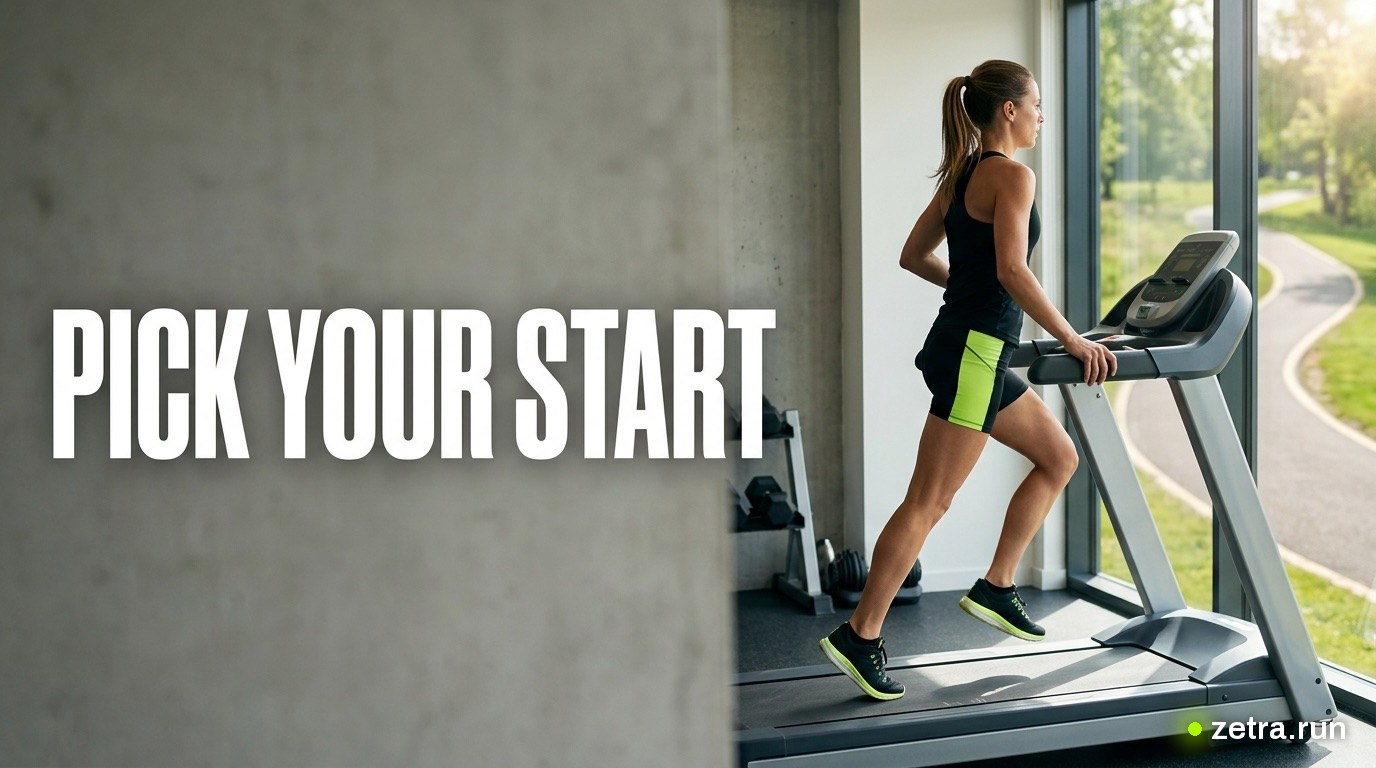
The best place to start running is the one that removes the most friction.
If you are choosing between treadmill vs running outside, start where you can repeat runs calmly and consistently. For many beginners, that is the treadmill: no weather, no route planning, easy walk breaks, steady pace, and a softer, predictable surface. For others, outside wins because it feels less boring, builds real-world confidence, and teaches your body to handle wind, turns, small hills, and uneven ground.
There is no moral victory in choosing the “harder” option. Your first job is to build the habit without turning every run into a test. Pick the place where you are most likely to get out the door, slow down, and come back two days later.
Is treadmill or outside better for beginner runners?
The better starting choice is the one that helps you run easy, stop before you overdo it, and repeat the session next week.
That answer may sound too simple, but it matters. Beginners often ask the treadmill vs running outside question as if one option is “real running” and the other is a shortcut. That is the wrong frame.
Running is running. Your heart still works. Your legs still absorb load. Your breathing still tells you when the pace is too high. A treadmill mile and an outdoor mile are not identical, but both can make you fitter if the effort is right.
The difference is the environment.
A treadmill controls the environment for you. The belt speed stays steady. The surface stays flat. The weather disappears. You can step to the side rails, slow to a walk, or stop without being a mile from home.
Outside gives you the real thing. Wind, corners, small slopes, curbs, temperature, and terrain all change the run. Your body learns to manage pace without a screen. Your mind gets more to look at. You build confidence moving through the world, not just finishing a workout.
Neither is always better.
If you are nervous, coming back after years away, running before sunrise, or dealing with winter weather, the treadmill may be the better first step. If the treadmill makes ten minutes feel endless, outside may be easier to stick with even if the effort feels a little harder.
Start with consistency. Specificity can come later.
Why does treadmill running feel easier than outside?
Treadmill running often feels easier because the environment is controlled: no wind, no changing surface, no route decisions, no downhill pounding, and no surprise hills.
You are also not pushing through moving air in the same way you do outside. At easy beginner speeds, that difference may be small, but it can still be noticeable, especially when you move from a gym to a breezy path.
The surface matters too. Many treadmills feel more cushioned than pavement. That can make early run-walk sessions feel smoother on your feet and lower legs. It does not remove impact, but it may reduce some of the harshness you feel on concrete.
Then there is pacing. Outside, beginners usually start too fast because the first minute feels fine. By minute four, your breathing is ragged and your legs are burning. On a treadmill, you can set a speed that forces patience. That is a real advantage.
The belt assistance debate gets overcomplicated. Some runners say the treadmill “pulls your foot back” and makes running fake. In practice, you still have to lift your body, land, stabilize, and keep moving. The mechanics are different, but not worthless. The treadmill is a training tool, not a lie detector.
A better way to think about it:
Treadmill running is usually more controlled. Outdoor running is usually more variable. Controlled often feels easier.
That does not make it worse for beginners. It may be exactly what lets you run slowly enough to build the base.
If pacing is your main problem, read easy run pace. Most beginners do not need more toughness. They need a pace that lets the body adapt.
Should beginners start on a treadmill?
You should start on a treadmill if it makes running safer, simpler, or less intimidating.
That includes bad weather, dark mornings, icy sidewalks, no safe route nearby, or anxiety about being watched outside. It also includes practical life stuff: childcare, time limits, gym access, or needing a bathroom close by.
The treadmill is especially useful for run-walk training. You can set a slow run speed, drop to a walk without thinking, and repeat. That makes plans like couch to 5k easier to control when you are new.
Here is a simple way to choose.
| Your situation | Better starting choice | Why |
|---|---|---|
| You are worried about traffic, darkness, or personal safety | Treadmill | You remove route stress and can focus on effort |
| You always start too fast outside | Treadmill | The speed setting forces restraint |
| You get bored quickly indoors | Outside | Changing scenery keeps your mind engaged |
| Weather stops you from running often | Treadmill | You protect consistency |
| You are training for a road 5K soon | Both, with some outdoor running | You need practice on the surface and conditions you will race in |
| You are nervous about being far from home | Treadmill or short outdoor loops | Walk breaks and stopping feel easier |
| Your legs feel beaten up on pavement | Treadmill first, then gradual outdoor runs | A predictable surface can be a gentler entry |
| You need mental quiet and fresh air | Outside | The run may feel less like a workout you have to endure |
The best choice may change by day. That is allowed.
A beginner who runs twice a week on a treadmill and once outside is not confused. They are building options. Options help you stay consistent.
Is running outside better training than the treadmill?
Running outside is better training for outdoor races and real-world pacing because it includes wind, terrain, turns, temperature, and surface changes.
That is called specificity. Training that looks like your goal prepares you better for that goal.
If your goal is to finish a local 5K, you should eventually run outside at least some of the time. Your feet, calves, hips, and attention need practice with small changes: a slanted road, a tight turn, a shallow hill, a headwind, a curb cut, a patch of uneven path.
Outdoor running also teaches pacing without a machine. That skill matters. In a race, nobody sets the belt for you. You need to feel the difference between “comfortable,” “working,” and “too fast.”
But “better training” does not mean “better starting point.”
If running outside makes you quit after one week because the weather is awful or the route feels unsafe, it is not better for you right now. A perfect training environment that you avoid is useless.
Use outside running when it adds value:
- One short outdoor run per week once the habit feels stable
- Outdoor run-walk intervals on a flat loop
- Easy runs on paths or quiet streets before trying hills
- A few outdoor runs in the shoes and clothes you plan to use for a race
Keep the effort easy. Your first outdoor runs may feel harder at the same pace. That is normal. Do not force the treadmill pace onto the road. Let the effort guide you.
Should you set the treadmill to 1% incline?
You can set the treadmill to 1% incline if you want outdoor effort to feel a little closer, but it is a rough convention, not a law.
The idea behind 1% incline is simple: it may offset some of the missing outdoor air resistance at certain speeds. Coaches often use it as a practical habit. It is not a magic correction that makes every treadmill run equal to outside.
For beginners, the bigger issue is effort.
If 1% incline makes your easy run turn into a grind, leave the treadmill flat. A calm flat run is better than a “more realistic” run that pushes you too hard. You can add incline later when your body has adjusted.
Use these simple rules:
- For easy beginner runs, 0% is fine.
- If flat treadmill running feels too easy compared with outside, try 1%.
- For walk breaks, use whatever incline lets you recover.
- Avoid steep incline running early unless the workout is meant to be a hike-style walk.
- If your calves or Achilles area get cranky, reduce incline and see a professional if pain persists.
Incline changes the load. You may feel it in your calves, ankles, and hips. That is not bad by itself. It just means you should add it gradually.
Do not let a setting become a badge of honor. The right incline is the one that supports the purpose of the run.
How do you move from treadmill running to outside?
Move outside gradually by keeping the same easy effort, shortening the first few outdoor runs if needed, and using walk breaks before you feel desperate.
Your body is dealing with new inputs. The ground is firmer or less even. Wind changes your breathing. Small hills appear even on “flat” routes. Your pace may jump around. That does not mean you lost fitness. It means the task changed.
A simple transition works well:
- Keep most runs where you are comfortable.
- Add one short outdoor run per week.
- Choose a flat route or loop.
- Run by effort, not treadmill pace.
- Use planned walk breaks.
- Add time slowly.
If you have been doing 30 minutes on the treadmill, your first outdoor run does not need to be 30 minutes. Try 15 to 20 minutes with walk breaks. Finish feeling like you could do more.
That feeling is the point.
The common mistake is trying to prove the treadmill fitness “counts” by matching your treadmill pace outside. You do not need to prove anything. You need to adapt.
Watch for these signs that the transition is going well:
- Your breathing settles sooner after the first few minutes
- You stop checking pace every few seconds
- Small hills feel manageable, even if slower
- You finish with normal tiredness, not a wrecked feeling
- You can run outside again within a few days
If pain changes your stride, gets sharper as you run, or keeps returning, stop guessing and see a professional.
How do you make treadmill running less boring?
Treadmill running gets less boring when you give your brain a job and stop staring at the clock.
The treadmill’s biggest weakness is sameness. Same wall. Same belt. Same numbers. For some beginners, that makes the run feel longer than it is.
Fix that with structure.
Try one of these:
- Run-walk blocks: 1 minute easy run, 1 minute walk, repeat.
- Tiny pace changes: Every 3 to 5 minutes, adjust speed slightly while keeping effort easy.
- Incline waves: Add a small incline for 1 minute, then return to flat.
- Screen-free chunks: Cover the display for one song, then check in.
- Audio cue runs: Use music, podcasts, or coaching cues to break the run into pieces.
- Form focus rounds: Spend one minute relaxing shoulders, one minute quieting your feet, one minute keeping your breathing calm.
Do not turn every boredom fix into a hard workout. Beginners often make treadmill runs more exciting by making them too intense. That works for one day. Then the next run feels awful.
Your goal is steady repetition.
If the treadmill still feels unbearable, believe that signal. You may be an outdoor runner. Some people need trees, turns, weather, and distance from the laundry pile. That is not a discipline problem. It is useful information.
Frequently asked questions
Is treadmill running easier than outside?
Usually, yes. Treadmill running often feels easier because there is no wind, the surface is predictable, the pace is controlled, and there are no surprise hills or turns. That does not make it fake. It just means you should use effort, not ego, when comparing treadmill pace with outdoor pace.
Should I set the treadmill to 1% incline?
You can, but you do not have to. The 1% incline idea is a rough convention used to make treadmill running feel a bit closer to outdoor effort. For beginners, flat treadmill running is fine if it helps you stay easy and consistent. Add incline gradually if it feels useful.
Can I train for a 5K on a treadmill?
Yes, you can build a lot of 5K fitness on a treadmill, especially with run-walk training and easy runs. If the race is outside, add some outdoor runs before race day so your body and pacing skills adjust to wind, turns, pavement, and small hills.
Why is outdoor running harder?
Outdoor running is harder because the environment keeps changing. You deal with wind, temperature, uneven surfaces, road camber, turns, and small climbs. You also have to control pace yourself. Slow down outside until your breathing matches the effort you can hold on the treadmill.
Is treadmill running bad for you?
Treadmill running is not bad for you by default. It can be a safe, useful way to start because the surface and pace are controlled. Problems usually come from doing too much too soon, running too hard, or ignoring pain. If pain persists or changes how you move, see a professional.
Start where running feels repeatable, not where it looks most impressive. If that is the treadmill, use it. If that is outside, go outside and slow down more than you think. And if you want live cues while you run, Zetra can react to your heart rate, pace, and cadence in real time so you are not guessing mid-run.
Run with a coach in your ear.
Zetra guides you live — heart rate, pace and cadence — on every run.