Why Do My Legs Hurt After Running? Sore or Serious?
By the Zetra Coaching Team
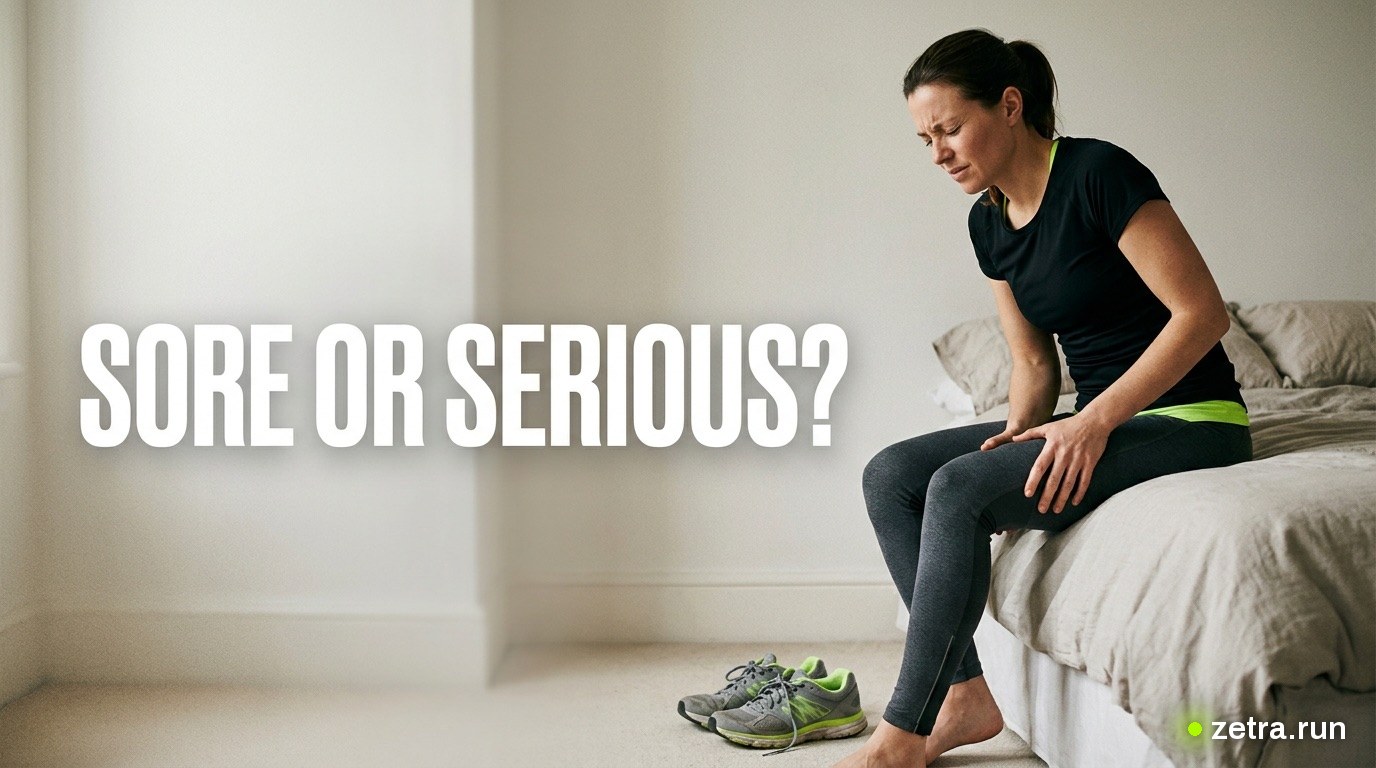
Heavy, aching legs after a run are normal until the pattern changes.
If your legs hurt after running, the most likely cause is delayed-onset muscle soreness, often called DOMS. It usually shows up after a run your body was not ready for yet: longer, faster, hillier, or just your first run in a while. Normal soreness feels broad, dull, and usually shows up in both legs. It often peaks the next day or two, then eases with light movement.
The concern starts when the pain is sharp, in one exact spot, mostly on one side, changes your stride, or gets worse each time you run. That is no longer “just sore legs” until proven otherwise.
Your job is not to panic. Your job is to read the pattern.
Why are my legs sore after running?
Your legs are sore after running because running asks your muscles, tendons, bones, and connective tissue to handle repeated impact. If that load is new, your body complains while it adapts.
That soreness is not failure. It is feedback.
Running is not just “cardio.” Every step is a small landing. Your calves help control your ankle. Your quads help absorb impact. Your glutes and hamstrings help push you forward and stabilize your hips. If you are new, returning after time off, or changing your route, those tissues may be getting more work than they have had lately.
DOMS is the common version of this. It tends to happen after unfamiliar load, especially downhill running, faster running, hills, strength training, or a sudden jump in distance. You may feel fine right after the run, then wake up stiff the next morning. Sometimes the second day feels worse than the first.
That delay is what confuses beginners.
You think, “But I felt okay yesterday.”
Your body answers, “Yes. Now I am repairing.”
Normal post-run soreness usually feels like:
- A dull ache
- Heavy legs
- Tender muscles when you press them
- Stiffness when you first stand up
- Discomfort that improves once you walk around
- Similar soreness on both sides
That last point matters. Both calves sore after your first run? Common. One sharp spot on the inside of one shin that hurts more every run? Different conversation.
How do I know if leg pain is soreness or an injury?
Normal soreness is broad, dull, and improves as your body warms up. Injury-type pain is often sharp, focused, one-sided, and gets worse with running.
Use the pattern before you use the worry.
| Soreness pattern | Likely meaning | What to do |
|---|---|---|
| Both legs feel heavy or achy the day after a new run | Normal post-run soreness or DOMS | Walk, move gently, sleep, eat well, and keep the next run easy |
| Soreness peaks one or two days later, then starts easing | Typical delayed soreness | Wait it out. Do not test yourself with a hard run |
| Stiff at first, better after 10–15 minutes of easy movement | Usually manageable soreness | Easy run or walk-run may be okay if your stride stays normal |
| One exact spot hurts, especially on one side | Possible injury signal | Stop running through it and monitor closely |
| Sharp pain, stabbing pain, or pain that changes your stride | Not normal soreness | Do not run on it. See a professional if it persists or concerns you |
| Pain gets worse during the run or worse each run | Load is too high or something is irritated | Back off. Rest or cross-train. Seek help if it keeps returning |
| Swelling, bruising, numbness, or pain after a fall or twist | Needs more caution | Avoid running and see a medical professional |
| Pain at rest or pain that wakes you at night | Not typical DOMS | See a professional |
This is where beginners often make the wrong call in both directions.
Some people quit at the first sign of sore legs. They assume soreness means running is damaging them.
Other people push through clear warning signs because they have heard “no pain, no gain.”
Both are bad coaching.
Mild soreness can be part of adaptation. Pain that changes how you move is a signal to stop and reassess. If you want a deeper checklist, read pain red flags.
Why do beginners and returning runners get sore legs most?
Beginners and returning runners get sore legs most because their motivation usually improves faster than their tissues adapt.
Your lungs and mood can talk you into more. Your calves may not agree yet.
When you start running, your aerobic system can often handle a little more before your legs are ready. You might run until you are out of breath, stop, recover, then repeat. That can be a good start. But if every run becomes a test, your legs never get the quiet repetition they need.
Returning runners get caught by memory.
You remember what your normal run used to feel like. Maybe three miles was easy. Maybe you had a regular loop. Maybe you used to run without thinking about your calves at all.
Then you come back and try to run like the old version of you.
Your brain remembers the route. Your tissues remember the break.
That gap creates soreness.
Common beginner and returning-runner triggers include:
- Running too fast for an “easy” run
- Adding distance before your legs have adapted
- Running hills early
- Running too many days in a row
- Starting with continuous running when walk-run would be smarter
- Wearing very different shoes than your body is used to
- Adding strength training and running at the same time
The fix is not to baby yourself forever. The fix is to progress in a way your body can absorb.
The 10% rule says not to increase weekly mileage by more than 10% at a time. It is a useful brake for some runners, but it is not a law. If you run very little, 10% may be too tiny to matter. If you are sore all the time, even 10% may be too much. Let your legs and your next-day pattern help guide the plan.
Is it OK to run when your legs are sore?
It can be okay to run with mild soreness if the soreness is even, dull, improves as you warm up, and does not change your stride.
Keep the run easy. Very easy.
That means you can speak in short sentences. Your breathing is controlled. You are not chasing pace. You finish feeling like you could have done more.
If the first few minutes feel stiff, walk first. Then jog lightly. If the soreness fades and your stride feels normal, an easy run may be fine.
If the pain sharpens, stays in one spot, makes you limp, or gets worse as you go, stop. Walk home. That is not weakness. That is useful information.
Here is a simple decision filter:
- Green light: mild, general soreness in both legs; better with movement; normal stride.
- Yellow light: soreness stronger than usual; legs feel flat; you can move normally but feel beat up. Choose a walk, rest day, or very short easy run.
- Red light: sharp, one-sided, worsening, swollen, or stride-changing pain. Do not run through it.
Rest days are not empty days. They are when your body catches up to the training you already did. If you struggle to take them, read rest days.
What helps sore legs after running?
The best help for sore legs is boring: easy movement, sleep, enough food, hydration, and patience.
You do not need a complicated recovery routine after every beginner run. You need to stop adding stress faster than your body can adapt.
Start with easy movement. A short walk later in the day can make stiff legs feel better. Gentle cycling can work too if you have access to it. The goal is blood flow and comfortable motion, not another workout disguised as recovery.
Sleep matters because adaptation happens after training, not during it. One bad night will not ruin you. A pattern of poor sleep makes every run feel harder than it should.
Food matters too. If you run and then under-eat, your body has less to work with. You do not need a perfect post-run meal. You do need enough overall energy, plus protein and carbohydrates across the day. Protein helps repair tissue. Carbohydrates help refill the fuel you used.
Hydration helps if you are dehydrated, but water is not a magic soreness cure. Drink normally. If it is hot, you sweat heavily, or the run is longer, you may need more fluid and some salt. Do not force huge amounts of water because your calves feel sore.
Now the oversold stuff.
Aggressive stretching is not a fix for DOMS. Gentle stretching can feel good. Forcing sore muscles into deep positions can make them more irritated. If stretching changes your breathing or makes you grit your teeth, back off.
Ice is not needed for every sore leg. It can numb pain and may be useful in some acute situations, but normal delayed soreness does not require icing as a rule. If ice feels good, fine. Do not treat it like a required ritual.
Massage, foam rolling, compression, hot baths, and recovery boots may help you feel better. The effect varies. Use them if they make you more comfortable and do not turn recovery into another pressure project.
The main fix is load management.
Run easier. Build slower. Keep most runs comfortable. If every run leaves you wrecked for days, the plan is too hard right now.
Why are my legs sore two days later?
Your legs can be sore two days later because delayed-onset muscle soreness often peaks after the first day, especially after unfamiliar running.
That does not mean you made the soreness worse by sleeping. It means the repair process is still underway.
This is common after:
- Your first run in weeks or months
- A longer run than usual
- Downhills
- Speed work
- A hilly route
- A hard strength session close to the run
- Running faster because you felt good early
The second-day ache can be annoying because it arrives late. You may think the run “caught up with you.” In a way, it did.
Treat day-two soreness as a message about your next choice. If your legs are stiff but loosen up during a walk, keep moving gently. If stairs feel rough, skip the hard workout. If the pain is one-sided or sharp, stop guessing and use the injury filter.
You do not need to erase soreness before you run again. You do need to avoid stacking hard stress on top of soreness that is already high.
A beginner mistake is turning every good day into a bigger day.
You feel better, so you run farther. Then you get sore. Then you rest until you feel better. Then you run too far again.
That cycle builds frustration more than fitness.
The better pattern is smaller runs you can repeat. A run that feels almost too easy today may be exactly what lets you run again in two days.
When should I see someone for leg pain after running?
You should see a professional if leg pain is sharp, one-sided, focused in one spot, worsening, linked to swelling or bruising, changes your stride, or does not improve with rest.
Also get help if the pain follows a fall, twist, or sudden pop, or if you have numbness, unusual weakness, chest pain, faintness, or symptoms that feel alarming. Running advice cannot diagnose you through a screen.
Persistent pain deserves attention. You do not need to wait until you can barely walk.
For beginners, the most common mistake is asking, “Can I push through this?”
A better question is, “What happens if I make this easier for a week?”
If the pain fades when you reduce running, that points toward load being too high. If it returns in the same exact spot every time you try again, get it checked. If it keeps worsening despite rest, see someone.
A professional can help you sort out whether this is training load, footwear, strength, mobility, gait, or something that needs medical care. That is not overreacting. It is how you stay in the sport long enough to improve.
Frequently asked questions
How long should legs be sore after running?
Mild leg soreness after running often lasts a couple of days, especially after a new or harder run. It should trend better, not worse. If soreness hangs around, keeps returning in the same spot, or changes how you walk or run, treat it as more than normal soreness and see a professional if it persists.
Is it OK to run with sore legs?
It can be okay if the soreness is mild, dull, general, and improves as you warm up. Keep the run easy and short. Do not run through sharp pain, one-sided pain, swelling, limping, or pain that gets worse during the run.
What helps sore legs after running?
Easy walking, gentle movement, sleep, enough food, and time help most. Keep your next run easy or take a rest day if the soreness is strong. Be careful with aggressive stretching, hard massage, or using ice as a cure for everything. Comfort is fine. Forcing recovery is not.
Why are my legs sore two days later?
That delayed soreness is common after unfamiliar running load. Your legs may feel worse a day or two after the run because your muscles are still responding and repairing. If the soreness is broad and easing, it is usually normal. If it is sharp, one-sided, or worsening, be more cautious.
When is leg pain not normal soreness?
Leg pain is not normal soreness when it is sharp, focused in one spot, mostly on one side, gets worse as you run, changes your stride, or comes with swelling, bruising, numbness, or pain at rest. Stop running through it and see a professional if it persists or worries you.
Heavy legs after running are usually not a warning that you are bad at running. They are a sign that your body met a load it has not adapted to yet. The skill is knowing when to move gently, when to rest, and when the pattern has changed enough to get help. Zetra helps with that judgment in real time by coaching your run from your Apple Watch and iPhone, reacting to your heart rate, pace, and cadence while you are actually out there.
Run with a coach in your ear.
Zetra guides you live — heart rate, pace and cadence — on every run.