How to Run Downhill Without Wrecking Your Quads
By the Zetra Coaching Team
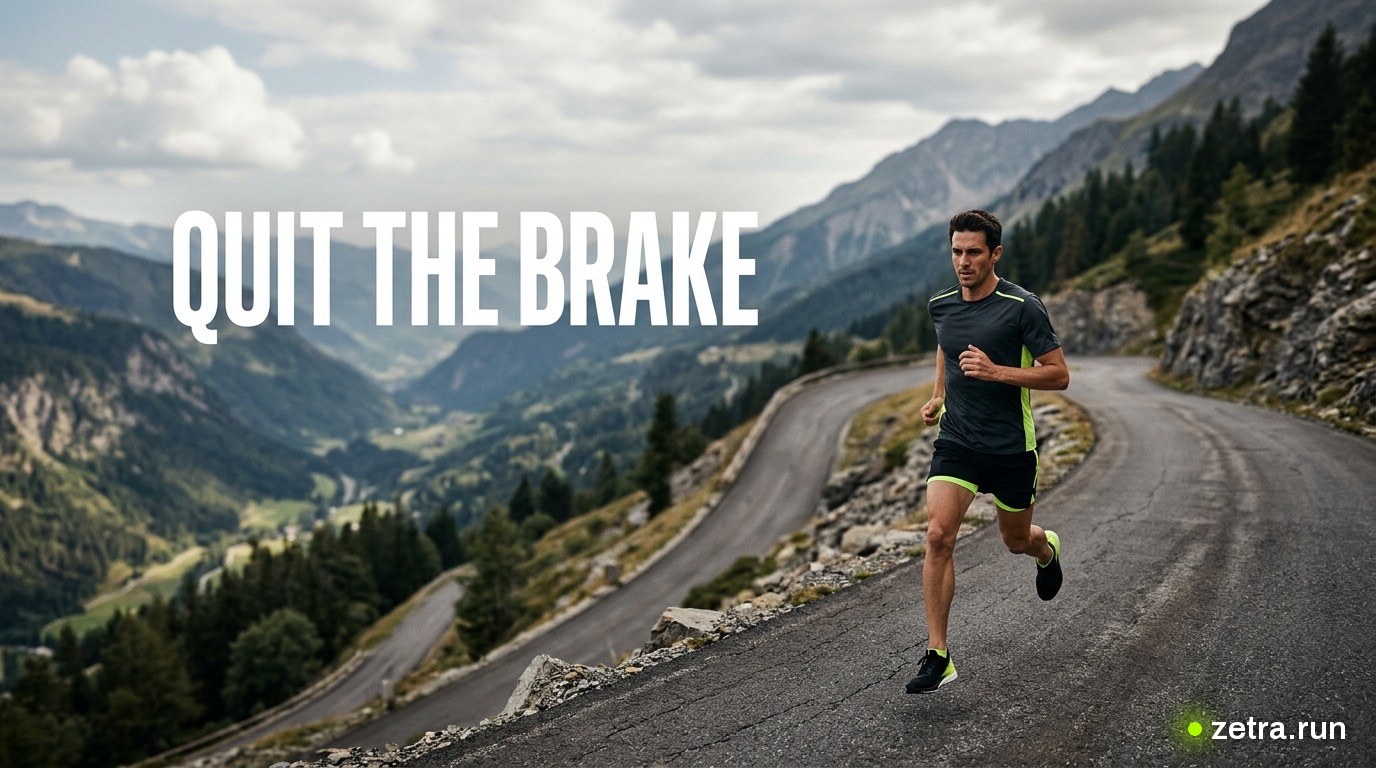
Downhills feel like free speed right up until the next morning.
If your quads are wrecked after a downhill race, the fix is not to “toughen up” or avoid hills forever. You need to stop braking with a stiff leg out in front of you. Run downhill with slightly quicker, shorter steps, let your feet land closer under your body, keep your posture tall instead of leaning back, and stay loose enough to let gravity help you.
The soreness happens because your quadriceps are working while lengthening. They are trying to control your body as gravity pulls you down the hill. That lengthening-under-load action, called an eccentric contraction, typically causes more muscle damage and next-day soreness than the same effort on flat ground.
That is why a hilly race can leave you limping down stairs even if your pace was slower than a flat race.
Why do my quads hurt so much after downhill running?
Your quads hurt after downhill running because they are acting like brakes.
On flat ground, your quads help stabilize your knee and support your stride. On a downhill, they have a harder job. Every step is a controlled fall. Gravity pulls you forward and down. Your quads lengthen while they resist that pull, especially when your foot lands far in front of your hips.
That is the part that trashes you.
A muscle can work in different ways. It can shorten to produce force, like your calf pushing you off the ground. It can hold steady, like your core keeping your torso from folding. Or it can lengthen while under tension, like your quads lowering you down a hill.
That last one is the downhill problem.
Eccentric loading is not bad. It is part of running. It is also part of strength training. But when you get a lot of it at once, especially in a race, your legs can feel fine during the run and destroyed later.
This is the trap. Downhill running often feels easier on your lungs than climbing. Your breathing settles. Your pace drops. You think you are getting free speed.
Your quads are paying the bill quietly.
The steeper the hill, the longer the descent, and the more you brake, the bigger that bill gets. That is why a fast flat race and a hilly race can feel like two different sports the next morning. The flat race may stress your lungs, calves, and overall fatigue more. The hilly race adds a big dose of braking damage.
If you want the bigger picture on normal soreness versus something that needs attention, read why do my legs hurt after running. Downhill soreness has its own flavor: heavy quads, sore stairs, and a feeling that your thighs have been beaten from the inside.
How do I run downhill without braking?
You run downhill well by reducing braking, not by forcing speed.
The biggest mistake is planting a stiff leg far out in front of you. It feels safe because your foot is reaching for the ground. But that reach turns your leg into a brake. Your heel or whole foot hits ahead of your center of mass. Your knee takes load. Your quads have to slow you down. Repeat that over and over in a race, and your legs remember.
The better feeling is this: your feet touch down under you, your steps are a little shorter, and your cadence is slightly quicker. You are not sprinting. You are letting your legs turn over so each step carries less braking force.
Think “quiet feet.”
If your feet slap loudly on the road, you are probably overstriding or getting tense. If your shoulders are up by your ears, you are probably fighting the hill. If your torso is leaning back, you are asking your quads to act like a handbrake.
Stay tall. Let your ankles and hips move. Keep your eyes a few steps ahead, not straight down at your shoes. Let your arms balance you without crossing wildly in front of your chest.
You are still in control. You are just not trying to stop gravity on every step.
| Descending mistake | What it does to your legs | The fix |
|---|---|---|
| Leaning back | Turns each step into a braking action and loads your quads harder | Keep your torso tall and stacked over your hips |
| Reaching your foot far ahead | Makes your leg act like a brake before your body passes over it | Take slightly shorter steps and land closer under you |
| Locking or stiffening the knee | Sends more impact through the knee and thigh | Keep a soft knee and let the leg absorb the ground |
| Overstriding because the pace feels easy | Adds hidden quad damage while your breathing feels fine | Use quicker turnover and stay controlled |
| Tensing your shoulders and arms | Makes the whole stride rigid and choppy | Relax your hands, drop your shoulders, and let your arms balance |
| Charging the first descent | Burns your quads early before you notice the damage | Start controlled, then let speed come later if your legs still feel good |
Do not force a perfect foot strike. Trying to land on a specific part of the foot can make you stiff. The better target is where the foot lands relative to your body. Under you is usually kinder than way out in front.
Should I lean back when running downhill?
No. Leaning back is usually the braking position.
A small amount of body angle will happen naturally depending on the slope. You do not need to fold forward from the waist or throw yourself down the hill. But if your chest is leaning away from the descent and your feet are reaching ahead, you are fighting the hill with your quads.
Picture your posture like this: tall head, ribs over hips, hips over feet. Your body is organized. Your ankles can move. Your stride can roll underneath you.
Now picture the bad version: chest lifted too far back, pelvis behind you, heel stabbing down the hill. That version feels careful, but it creates the exact loading that makes your quads sore.
The cue is not “lean forward.” That can turn into bending at the waist and losing control.
Use this instead:
- Stay tall.
- Let your feet come back underneath you.
- Keep your steps quick enough that you do not have time to reach.
- Let your arms move lightly for balance.
- Keep your jaw and hands relaxed.
Downhill running should feel like controlled flow, not like stomping.
If you are used to muscling every descent, this will feel strange at first. You may feel as if you are allowing the hill to carry you. That is the point. You are still choosing the effort. You are just spending less energy fighting the ground.
How should I run steep downhills versus gentle downhills?
Gentle downhills are where you can let rhythm do most of the work. Steep downhills require more control and less ego.
On a gentle grade, your job is to stay smooth. Keep your stride compact. Let your cadence rise naturally. Do not chase the pace on your watch just because the number looks good. If your breathing is easy but your feet are pounding, your quads are still taking a hit.
Gentle downhills are the best place to practice. They teach you the feeling of light, fast turnover without panic.
Steep downhills are different. You may need to reduce speed more. The goal is not to fly. The goal is to arrive at the bottom with legs you can still use.
On steeper slopes:
- Shorten the stride more.
- Keep the knee soft.
- Avoid leaning back hard.
- Use your arms for balance.
- Look ahead for your line instead of staring at the ground directly under you.
- Accept that controlled is faster than reckless over the full race.
Trail descents add another layer because footing changes. Road descents are more repetitive, which can mean more repeated loading in the same tissues. Neither is automatically safer. The risk comes from speed, stiffness, fatigue, and how ready your legs are for the descent.
This is similar to climbing in one way: technique changes with the grade. If you are working on hills in both directions, the companion skill is uphill running technique. Uphills ask you to manage effort. Downhills ask you to manage impact and braking.
Why is the first downhill of a race so dangerous?
The first downhill is dangerous because your legs are fresh and your breathing lies to you.
Early in a race, downhill pace feels easy. You are excited. Other runners are moving. Your watch says you are ahead. Your lungs are not complaining yet.
So you let the hill pull you faster than your legs are ready to absorb.
The damage starts before the pain does. Your quads can take a heavy eccentric load early and still feel normal for a while. Later, when the course flattens or climbs, you discover that your legs have lost their snap. The soreness may arrive after the race, but the cost was paid during those early descents.
This is why the first descent should feel almost too controlled.
You do not need to jog timidly. You do need to avoid the hard braking pattern: long stride, stiff knee, leaning back, pounding feet. Let the speed come from smooth turnover, not from throwing yourself down the hill.
A good race rule is simple: on the first downhill, protect your quads. On later downhills, spend what you still have.
That choice feels boring in the moment. It feels smart near the finish.
If you have been destroyed by a downhill race before, you already know this. The problem was probably not one dramatic mistake. It was a lot of small braking steps taken while the pace felt free.
How do I train for downhill running without wrecking my knees?
Train downhill running gradually because the exact stress that makes you sore is also the stress your body adapts to.
You cannot fake downhill conditioning entirely on flat ground. Strength work can help. Better general fitness can help. But if your race has long descents and you never practice descending, your quads meet a new load on race day.
That is risky.
Start with short, controlled downhill practice on a gentle slope. Keep the effort easy. Focus on form before speed. You are teaching your legs to absorb the descent without panic, stiffness, or overstriding.
A simple progression looks like this:
- Add a few short downhill segments inside an otherwise easy run.
- Choose gentle hills before steep ones.
- Walk back or run easily between descents.
- Stop while your form still feels clean.
- Give your legs time to recover before adding more.
- Avoid adding downhill stress at the same time as a big jump in overall training load.
No magic rule protects you perfectly here. The well-known 10% rule is commonly used as a rough guardrail for increasing running volume, but it is not a law. Downhill stress can spike even when total distance looks reasonable. A short hilly run may beat up your legs more than a longer flat one.
That matters for knees, too.
Downhill running is a classic way to accumulate knee soreness if you introduce it too quickly. The knee is not the villain. The issue is load your body is not ready for yet, often combined with overstriding and braking. If pain is sharp, changes your stride, keeps returning, or does not settle, see a professional. If you suspect patellofemoral pain, start with this guide to runner’s knee.
You are not trying to become fearless on descents in one workout. You are giving your quads, tendons, and coordination repeated small chances to adapt.
That is how downhill stops feeling like damage and starts feeling like a skill.
Frequently asked questions
Why do my quads hurt after downhill running?
Your quads hurt after downhill running because they work while lengthening to control your body against gravity. That lengthening-under-load action is called an eccentric contraction. It typically creates more muscle damage and next-day soreness than the same effort on flat ground, especially if you brake with long, stiff steps.
How do I run downhill faster?
Run downhill faster by braking less, not by forcing longer strides. Keep your posture tall, take slightly quicker and shorter steps, land closer under your body, and stay relaxed through your shoulders and arms. On gentle downhills, let rhythm build speed. On steep downhills, control comes first.
Should I lean back running downhill?
You usually should not lean back when running downhill. Leaning back often makes your foot land farther in front of you, which increases braking and loads your quads. Stay upright and stacked over your hips. Let your feet move under you instead of reaching down the hill.
Is downhill running bad for your knees?
Downhill running is not automatically bad for your knees, but it can irritate them if you add too much too soon or run with a hard braking stride. Stiff legs, overstriding, and sudden hill volume are common problems. If knee pain is persistent, sharp, or changes how you run, see a professional.
How do I train for a downhill race?
Train for a downhill race by adding short, controlled downhill segments on gentle slopes before you try steeper or longer descents. Keep the first sessions easy and focus on quiet feet, soft knees, quick turnover, and upright posture. Build carefully because the muscle damage from descending is part of what you are adapting to.
Downhill running gets easier when you stop treating the hill like something to fight. Shorten the stride, soften the landing, stay tall, and let gravity give you speed without taking your quads as payment. Zetra can coach those cues live during the run, reacting to your heart rate, pace, and cadence while you descend.
Run with a coach in your ear.
Zetra guides you live — heart rate, pace and cadence — on every run.