GPS Pace Lies: Why Your Watch Disagrees on Race Day
By the Zetra Coaching Team
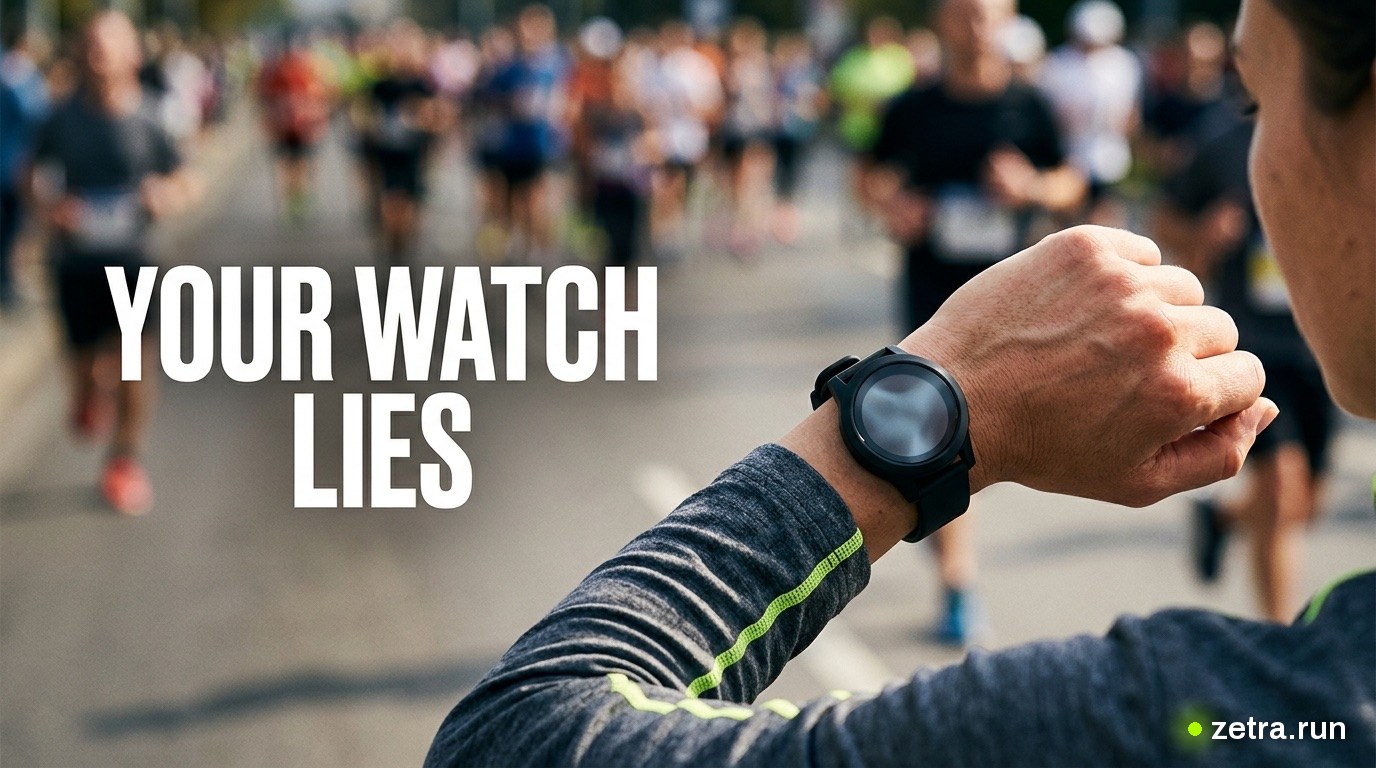
You cross the finish line and your watch insists the race was long.
The race probably was not long. Your watch says the race was long because a certified course is measured along the shortest legal line, while you run the actual line your feet took. That means wide turns, weaving around people, drifting to aid stations, starting far from the tangent, plus normal GPS error from buildings, trees, tunnels, and crowds. On race day, your watch is measuring a messy path through the real world. The course certificate measures the ideal legal path.
That gap can make your pace look wrong, too. Instant pace is especially noisy. It can lag, jump, or panic you into speeding up when you should stay calm.
Here is what to trust instead: course markers first, lap pace second, effort always. Your watch is a tool. It is not the race official.
Why does my watch say the race was long?
Your watch says the race was long because it records the path you ran, not the certified race line.
A certified road race is measured along the shortest possible legal route. Think tight to the inside of bends, straight from tangent to tangent, using the full road where the course allows it. That line is not how most runners actually move on race day.
You move around people. You swing wide on corners. You drift toward water tables. You start on one side of the road and finish a turn on the other. You may pass a group, tuck back in, then move out again. None of that feels like much in the moment, but over a 5K, 10K, half marathon, or marathon, it adds distance.
Your watch also has to guess where you are from satellite signals. That guess is usually good enough for training. It is not perfect. The signal can bounce near tall buildings. It can weaken under heavy trees. It can disappear briefly in tunnels or underpasses. When the signal comes back, your watch connects points and smooths the route. Sometimes that creates extra distance. Sometimes it cuts distance. Race day just makes the flaws easier to notice because you know the official distance.
A watch reading long does not prove the course was long.
It usually proves you did not run the exact measured line, and your GPS had to do some guessing.
Why is certified race distance different from my GPS distance?
Certified race distance is based on a controlled measurement. GPS distance is based on recorded position points while you are moving.
Those are different jobs.
A certified course measurer follows the shortest legal route with proper tools and a defined process. The goal is to make sure the course is at least the advertised race distance when run on that legal line. It is not trying to predict the distance every runner will cover from every starting position in every crowd pattern.
Your GPS watch works during the chaos.
It sees points. It connects points. It smooths bad points. It tries to ignore obvious errors. It also has to decide what to do when the signal is weak, when you stop briefly, when your arm swings, and when your route cuts close to buildings or trees.
That is why two runners in the same race can finish with different watch distances. One started nearer the inside of early turns. One ran wide to pass. One wore the watch under a sleeve. One had better satellite lock before the start. One ran through a pack. One crossed a road to grab fluids and crossed back again.
Same race. Different path. Different GPS file.
This matters most when you use watch distance to judge your result. If you finish a certified 10K and your watch says 10.18K, your official result is still your 10K time. The race clock does not care what your wrist thinks.
Why is instant pace so jumpy during a race?
Instant pace is jumpy because your watch is trying to turn small, imperfect location changes into a pace number right now.
That is a hard problem.
If your watch thinks you moved a little farther in the last few seconds, instant pace may show you flying. If it thinks you barely moved, instant pace may show you slowing. Under trees or near buildings, the number can swing even when your body feels steady.
Instant pace also lags. You surge up a hill, but the watch takes a few seconds to catch up. You settle back down, but the screen still shows the old effort. You panic, adjust again, and now you are chasing noise.
That is how a race plan falls apart.
For pacing, instant pace is useful only as a rough clue. It can help you notice if you are wildly off. It should not be the number you obey second by second.
Better options:
- Lap pace: your average pace for the current mile or kilometer.
- Manual laps: pressing lap at official course markers if your race has clear signs.
- Overall average pace: useful later in the race, less helpful in the first few minutes.
- Effort: your breathing, control, and ability to hold form.
- Heart rate trends: helpful when you know your zones, but not perfect in heat, hills, stress, or caffeine.
If you want a deeper pacing framework, read how to pace yourself. If heart rate is part of your race plan, make sure you understand heart rate zones before you use them on race day.
What should I trust instead of my GPS pace?
Trust the course, your lap splits, and your effort.
That order keeps you out of trouble.
The official course markers are your fixed reference. If you are racing a certified event, the mile or kilometer signs matter more than the distance field on your watch. Your watch may beep early or late. The sign is tied to the course.
Your lap pace is usually more useful than instant pace because it smooths a longer chunk of running. It still depends on GPS unless you use manual laps, but it does not react to every tiny signal wobble.
Your effort is the final check. If your watch says you are too slow but your breathing is already sharp at mile two of a half marathon, do not blindly speed up. If your watch says you are too fast but you feel controlled, on flat ground, with relaxed form, you may be fine.
A simple race-day setup works best:
- Show lap pace, not only instant pace.
- Show elapsed time, so you can compare against course clocks or mile markers.
- Show heart rate only if you know how your heart rate behaves in races.
- Turn off screen clutter you will not use.
- Use manual laps at course signs if you can do it without stress.
Do not build your whole race around a number that changes every few seconds.
Race pacing is not obedience to a watch. It is controlled decision-making under fatigue.
What is causing the GPS distance or pace problem?
Most race-day GPS problems have a simple pattern. Match the symptom before you change your pacing plan.
| Symptom | Likely cause | What to do |
|---|---|---|
| Your watch beeps each mile or kilometer before the course marker | You are running wider than the certified line, GPS is adding distance, or both | Use the course marker as truth. Consider manual laps at the signs. |
| Instant pace jumps from too fast to too slow while your effort feels steady | GPS noise, weak signal, or normal instant-pace lag | Ignore the swing. Watch lap pace and check your breathing. |
| The map shows you cutting through buildings, rivers, or blocks | Signal bounce or lost GPS lock | Do not judge the race by that file. Use official results and course markers. |
| Your distance is much longer after lots of weaving | You ran extra ground passing, dodging, or moving to aid stations | Start in the right corral next time and choose smoother lines. |
| Pace gets strange in tunnels, underpasses, dense trees, or downtown streets | GPS signal is blocked or reflected | Expect bad data there. Hold effort until the signal settles. |
| Two watches in the same race show different distances | Different GPS chips, settings, lock quality, smoothing, and running lines | Compare official splits, not just watch distance. |
The fix is not to distrust all data.
The fix is to know which data deserves your attention in that moment.
Should I run tangents in a race?
Yes, you should run tangents when it is safe and legal.
Running tangents means taking the shortest legal line through the course. On a curving road, you do not follow the outside edge of the bend. You look ahead and move smoothly toward the inside of the next turn, then back out if the next curve demands it.
You are not cutting the course. You are running the measured line more closely.
But do not turn tangent-running into chaos. Diving across a pack to save a few steps is a bad trade. You waste energy, break rhythm, and risk clipping someone. Smooth beats aggressive.
Use these rules:
- Look ahead, not down.
- Move gradually.
- Avoid sudden lateral moves in crowds.
- Take the inside of turns when space allows.
- Do not fight for the perfect line early if the race is packed.
- Be extra calm near aid stations.
Aid stations are where many runners add distance without noticing. They drift wide, grab a cup, slow down, move around someone, then drift back. That may be necessary. Just do it smoothly. If you know you will take fluids, move toward the table early instead of cutting across late.
The goal is not to run like a robot.
The goal is to stop giving away distance for no reason.
When should I distrust the watch entirely?
Distrust the watch when the data conflicts with the course, your body, and common sense.
A bad GPS file is usually obvious. Your map zigzags across streets you never crossed. Your pace spikes during a tunnel. Your distance jumps near tall buildings. Your watch says you slowed badly, but your official split and effort say otherwise.
In those moments, stop negotiating with the screen.
Use the race itself:
- Course signs.
- Official clocks.
- Known split points.
- Your breathing.
- Your form.
- The runners around you.
Heart rate can help, but it is not magic. Race nerves, heat, hills, poor sleep, dehydration, caffeine, and cardiac drift can all push heart rate higher than you expect. If you use heart rate, treat it as a trend, not a command.
Treadmill distance is a different case. Indoors, GPS is not available, so watches estimate distance from wrist motion, cadence, stride patterns, or paired sensors. That estimate can be close for some runners and poor for others. The treadmill itself can also be miscalibrated. If treadmill distance matters for a workout, use it consistently as a repeatable reference, but do not treat it as identical to an outdoor certified course.
Your watch is best when it supports your judgment.
It becomes a problem when it replaces it.
Frequently asked questions
Why does my GPS watch measure races long?
Your GPS watch measures races long because it records the path you actually ran, while the certified course is measured along the shortest legal route. Wide turns, weaving, aid station moves, crowded starts, trees, buildings, and tunnels can all add distance or GPS error.
How accurate are running watches?
Running watches are usually accurate enough for everyday training, but they are not exact measuring tools. Accuracy depends on satellite signal, route conditions, device settings, how long the watch had to lock on before the start, and how straight or messy your running line was.
Why is instant pace so jumpy?
Instant pace is jumpy because your watch is estimating your current speed from short bursts of GPS data. Small location errors become big pace changes on the screen. Use lap pace, manual splits, and effort instead of reacting to every instant-pace swing.
Should I run tangents in a race?
Yes, run tangents when it is safe and legal. That means taking the shortest smooth line through turns instead of following the outside of the road. Do not dart across crowds or cut off other runners. A clean line helps only if it does not cost rhythm and energy.
Can I trust treadmill distance?
You can use treadmill distance as a consistent training reference, but do not treat it as perfect. Treadmills can be miscalibrated, and watches estimate indoor distance without GPS. If the workout is effort-based, focus on time, effort, incline, and consistency.
Race day gets simpler when you stop asking your watch to be the official course measurer. Let the course set the distance. Let lap splits and effort guide the work. Zetra can coach you live during the run using pace, heart rate, and cadence, but the real skill is knowing when the number on your wrist is useful and when it is just noise.
Run with a coach in your ear.
Zetra guides you live — heart rate, pace and cadence — on every run.