Half Marathon Pacing: The Kilometer-by-Kilometer Plan
By the Zetra Coaching Team
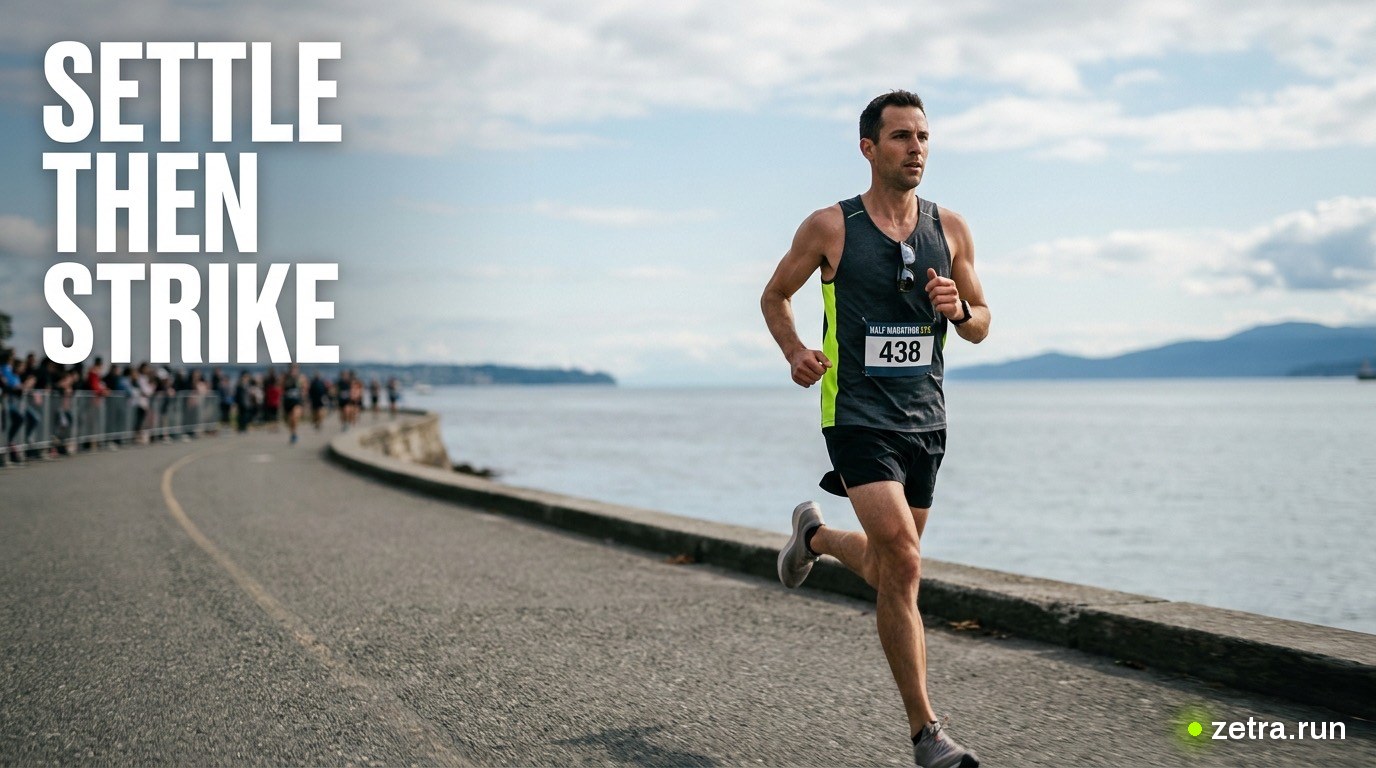
The first three kilometres of a half marathon can decide the last five.
A good half marathon pacing strategy is simple: start controlled, settle into goal effort, hold concentration through the middle, then spend what is left late. The half marathon is 21.1 km / 13.1 miles. That is long enough to punish a fast start and short enough that you cannot fully recover from one.
Your best race is usually even pacing or a slight negative split: the second half feels harder, but it is not much slower. That does not happen by accident. You have to let people pass you early. You have to trust effort before you trust the watch. And you have to know the difference between “comfortably working” and “already bargaining.”
How should you choose a realistic half marathon goal pace?
Your half marathon goal pace should come from recent training, not from hope, old fitness, or what your watch predicts on a good day.
Start with what you have actually done lately. Not one heroic workout. Not a downhill split with a tailwind. Look at repeated evidence:
- Long runs where you finished steady, not wrecked.
- Tempo or threshold efforts where your breathing was controlled but focused.
- Recent races over shorter distances, adjusted honestly for the fact that the half marathon is much longer.
- Training weeks you completed without needing extra rescue days.
A realistic goal pace should feel almost too controlled early. If goal pace already feels like racing in the first few kilometres / first few miles, it is probably not goal pace. It is wish pace.
Use this filter: could you imagine holding the effort for the full 21.1 km / 13.1 miles if nothing dramatic happens? If the answer depends on perfect weather, perfect legs, perfect crowds, and perfect caffeine, adjust. A pace that needs everything to go right is not a plan. It is a bet.
For your first half marathon, the better target is often an effort range, not a hard split. For an experienced runner chasing a time, you can be more specific, but the rule stays the same: your target has to match your current body, not your best memory.
Why is the start of a half marathon so easy to get wrong?
The start feels easy because adrenaline lies, the crowd pulls you forward, and your watch is often least useful when you most want certainty.
In the first few minutes, your body has not fully settled. Your heart rate may lag behind the work. Your breathing may feel calmer than it will once the pace starts to bite. The pack is moving. People surge around corners. You feel fresh because you are fresh.
That is exactly why the first 3-5 km / early miles need restraint.
The common mistake is thinking, “I’ll bank time now while I feel good.” In a half marathon, that usually works against you. You do not bank time for free. You borrow energy from the part of the race where you will need it most.
The correction is boring and disciplined: run the first section slightly calmer than goal effort. If your target pace appears on the watch, good. If it does not, do not panic. GPS can jump near tall buildings, trees, bridges, crowds, and tight turns. Early pace readings can be noisy. Instant pace is especially twitchy.
Use breathing instead.
In the opening phase, you should be able to breathe with control. You are working, but not chasing. You can speak a short phrase if you need to. Your stride feels smooth. Your shoulders are quiet. If your breathing is already ragged, you are not settling. You are spending.
What are the four phases of a smart half marathon pacing strategy?
A smart half marathon pacing strategy breaks the race into four phases: settle, rhythm, work, and commitment.
You are not trying to feel the same the whole way. You are trying to make the feeling change at the right time.
| Race phase | Distance | How it should feel | What to do if it already feels harder than that |
|---|---|---|---|
| The settle | First 3-5 km / early miles | Controlled, almost too easy, crowded, noisy, slightly held back | Ease off now. Let the pack go. Trust breathing more than instant pace. |
| The rhythm | To about 10 km / middle miles | Sustainable and boring. You are focused, but not fighting. | Stop forcing goal pace. Find steady effort and let the average pace recover gradually if it can. |
| The work | 10-16 km / middle-to-late miles | The cost arrives. You can hold pace, but it takes attention. | Shorten the mental target. Check form, breathing, and effort before you decide the race is gone. |
| The commitment | Last 5 km / last miles | Hard, honest, and simple. You spend what is left. | Hold effort first. If pace slips, keep moving well. Do not turn one slow split into a collapse. |
This is the point of pacing: you decide when the race is allowed to become hard.
If it becomes hard in the settle, you went too soon. If it becomes hard in the rhythm phase, you need to correct before the damage grows. If it becomes hard in the work phase, that is normal. If it becomes hard in the commitment phase, you are finally racing the half marathon you trained for.
How should the first 3-5 km feel?
The first 3-5 km / early miles should feel controlled enough that you wonder if you are being too cautious.
That feeling is uncomfortable for a different reason. You are not physically suffering yet. You are mentally resisting the urge to race everyone around you.
This is where you ignore the crowd.
People will pass you. Some are fitter. Some are starting too fast. Some are running a different race. None of that tells you what your pace should be.
Your job is to settle your breathing, find space, and avoid little surges. Surges are expensive because they break rhythm. You sprint around a group, brake at a corner, chase a gap, then look at your watch and see a pace that does not match how chaotic it felt. That is not free speed. That is noise.
Common error: checking the watch every few seconds and reacting to every jump.
Correction: use the watch as a rough guide, not a command. Let the early average form over time. Run the effort you planned. If your breathing is calm and your form is relaxed, you are probably close enough. If you feel sharp and impatient, good. Save it.
The half marathon does not reward the runner who feels best at the start. It rewards the runner who is still making decisions late.
What should goal pace feel like before halfway?
Before halfway, goal pace should feel sustainable and almost boring.
That does not mean easy. It means contained. Your breathing has a pattern. Your stride repeats. You are alert but not negotiating. You are not counting down every corner. You are not already promising yourself you will slow down later.
This rhythm phase usually carries you toward about 10 km / the middle miles. The exact course matters, but the job is the same: stop racing the start and begin racing your plan.
Common error: trying to “get back” time immediately after a slow opening split.
Correction: return to goal effort, not panic pace. If the first section was crowded or slightly slow, do not jam the next section to make the average look neat. That creates the same problem as a fast start, just with better excuses.
Even pacing is practical because it keeps the cost predictable. A slight negative split can work well because you start just controlled enough to run strongly late. For more on that, read negative splits. The point is not to perform a perfect mathematical trick. The point is to avoid lighting matches early and calling it confidence.
In this phase, effort and breathing still matter more than the watch. Your watch tells you pace. Your body tells you cost. Cost wins.
What should you do from 10-16 km when it starts to hurt?
From 10-16 km / the middle-to-late miles, the half marathon starts asking for payment.
This is not the dramatic final push yet. It is the work phase. The pace that felt smooth now needs attention. Your breathing is heavier. Your legs are not fresh. Small hills feel less small. You may start doing the math.
This is where concentration matters more than courage.
Courage says, “Push harder.” Concentration says, “Run the next section clean.” That means:
- Keep your shoulders loose.
- Keep your cadence steady without forcing it.
- Run the tangent where the course allows.
- Take the hill by effort, not ego.
- Let your breathing guide the pressure.
Common error: deciding too early that you are fading.
Correction: check the basics before you judge the whole race. Are you overstriding? Are you clenching your hands? Are you chasing someone else’s move? Are you letting one rough patch turn into a story?
A half marathon often has a messy section. That does not mean the race is broken. It means you are in the part where the plan stops feeling clever and starts feeling like work.
If your pace slips a few seconds per km/mile but effort is steady, stay calm. If effort spikes and breathing gets ragged, back off slightly before you redline. The goal is not to prove toughness at 10 km / the middle miles. The goal is to still have choices in the last 5 km / last miles.
How should you pace the last 5 km?
The last 5 km / last miles are where you commit.
You do not need to feel good here. You need to spend what is left without losing control. If you paced well, this is the first part of the race where a harder push makes sense. If you paced badly, this is where the early pace sends the bill.
Start by holding form. Late in a half marathon, “push” often turns into reaching with the stride, tightening the shoulders, and fighting the ground. That wastes energy. Think quick, compact, forward. Let your arms help your rhythm, not your panic.
Common error: waiting until you feel ready to go.
Correction: accept that ready may not arrive. The commitment phase is not comfortable. You increase effort because the finish is close enough for that effort to make sense.
If you have something left, squeeze gradually. Do not sprint from too far out because the distance is still real. If you are fading, narrow the task. Hold the next stretch. Get to the next marker. Keep your breathing under control. Passing one runner is useful only if it helps your rhythm. Chasing a surge that cracks you is not.
This is also where a controlled start pays you back. You are not magically fresh. You are just less damaged than you would have been.
How should you adjust half marathon pacing for hills, wind, and warm days?
Adjust your half marathon pacing by effort when the course or weather changes. Pace is the output. Effort is the control.
On hills, do not try to hold exact goal pace uphill. That usually costs too much. Let the pace slow while effort stays steady. Over the top, avoid the hard surge. Let your breathing settle, then return to rhythm. Downhill, take free speed only if it stays smooth. Braking and pounding can cost you later.
In wind, stop judging every split as if the air is neutral. A headwind can make goal pace too expensive. Run effort into the wind. Use groups when it is practical and safe, but do not weave wildly just to hide. With a tailwind, resist the urge to sprint. Let it help you, but keep the race shape intact.
On warm days, be more conservative early. Heat raises the cost of a pace that might have been fine in cooler conditions. If you force your original target because you wrote it down, the race may shrink fast. Adjust before you are desperate.
This is where how to pace yourself matters more than any perfect split chart. A good racer can change the number while keeping the plan.
Frequently asked questions
How should I pace a half marathon?
Pace a half marathon in four phases: settle for the first 3-5 km / early miles, find rhythm toward about 10 km / the middle miles, concentrate through 10-16 km / the middle-to-late miles, then commit over the last 5 km / last miles. Aim for even pacing or a slight negative split, using effort and breathing as your guide when the watch is noisy or the course changes.
Should the first mile be slower?
Yes, the first mile should commonly be a little slower than goal pace or at least feel easier than goal effort. The start is crowded, adrenaline is high, and GPS pace can be unreliable. A controlled first mile does not ruin your race. A reckless first mile can.
What is a good half marathon pacing strategy for beginners?
A good beginner strategy is to start easier than you think you need to, hold a steady effort through the middle, and only race hard in the final section if you still have control. For a first half marathon, effort is often a better target than exact pace. You want to finish knowing you managed the distance, not survive a mistake from the start.
Should I use a pace group in a half marathon?
A pace group can help if the target matches your real fitness and the pacer runs evenly. It can hurt if the group starts too fast, crowds your stride, or makes you ignore your breathing. Use the group as support, not permission to switch off. If the effort feels wrong early, let the group go.
How do I stop fading in the last 5K?
You stop fading in the last 5 km / last miles by spending less too early. Start controlled, avoid surges, adjust for hills, wind, and warm conditions, and keep the middle miles steady instead of brave. If fading keeps happening despite sensible pacing and training, review your goal pace honestly. If persistent pain is part of the fade, see a professional.
A half marathon pacing plan is not there to make the race easy. It is there to make the hard part arrive when you can use it. If you want live help staying honest while you run, Zetra coaches in your ear during the run and reacts to heart rate, pace, and cadence in real time.
Run with a coach in your ear.
Zetra guides you live — heart rate, pace and cadence — on every run.