Morning Running: Engineering the Habit That Sticks
By the Zetra Coaching Team
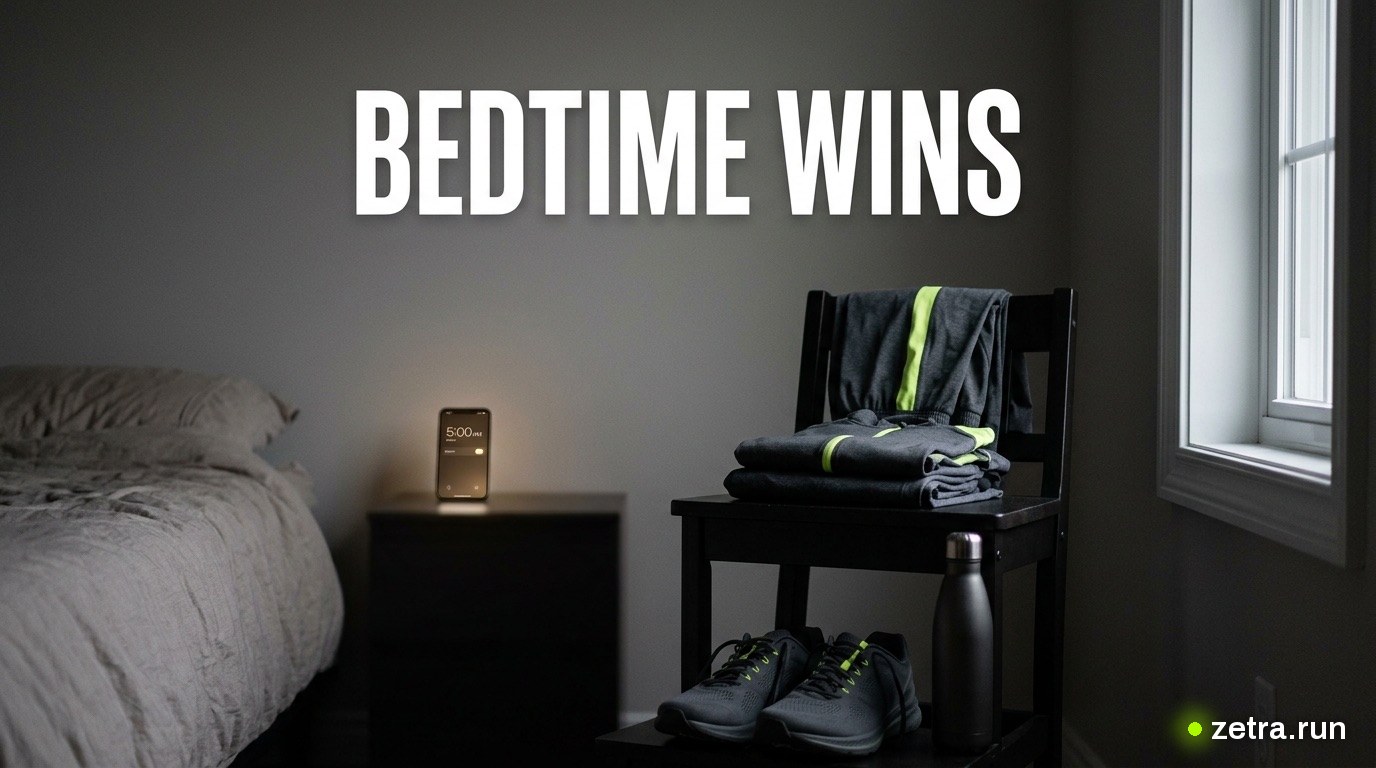
Morning running sticks when you remove every decision before your shoes go on.
If you want to start running in the morning, do not start by trying to become “a morning person.” Start by engineering one repeatable sequence: bedtime protected, clothes laid out, route chosen, alarm out of reach, first run almost too easy. The morning run is mostly decided the night before. Your job at 6 a.m. is not to negotiate. It is to stand up, get dressed, and begin.
That sounds small because it is.
Small is the point. Most failed morning running plans die in the gap between waking and starting. You lie there deciding whether you feel motivated, whether the weather is bad, whether you should run 20 minutes or 40. By the time you finish arguing with yourself, the run is gone.
Build the morning so there is nothing to argue with.
How do I make myself run in the morning?
You make morning running easier by removing choices before your alarm goes off. Motivation is too fragile for 6 a.m. Use setup instead.
Your morning self is not your best planner. It is warm, foggy, half-asleep, and very good at making reasonable excuses. So the plan has to be visible, simple, and already approved by your evening self.
Use this rule:
If it can be decided the night before, it should not be decided in the morning.
That includes:
- What you will wear
- Where you will run
- How long you will run
- Whether you will eat first
- What time you need to be in bed
- What counts as success
The last one matters. If your only “real” run is a perfect 45-minute session, you have made the habit too expensive. On hard mornings, success can be ten minutes easy. Or five minutes walking outside in running shoes. That still protects the identity you are building: when the alarm goes, you start.
You can make the first month almost boring:
- Pick three mornings per week.
- Use the same wake time.
- Run or run-walk for 10 to 20 minutes.
- Keep the effort easy enough that you could speak in short sentences.
- Stop while you still feel like you could do more.
Do not make week one a test of toughness. Make it a test of repeatability.
If you are starting from zero, a run-walk plan is enough. Couch to 5K is popular for a reason: it keeps the early steps small. You do not need to copy it exactly, but the principle is sound. Alternate short running with walking. Let your legs, lungs, and routine adapt together.
What should I do the night before a morning run?
Your morning run starts the night before because sleep, gear, route, and food all decide how much friction you face when you wake up.
Here is the table to screenshot.
| Friction point | The night-before fix |
|---|---|
| You snooze without thinking | Put the alarm across the room, close enough to hear, far enough that you must stand up |
| You waste time choosing clothes | Lay out the full kit: socks, shorts or tights, top, sports bra if needed, watch, headphones, shoes |
| You check the weather and start debating | Check once before bed and choose the exact outfit then |
| You do not know where to run | Pick a simple route with a clear turnaround point |
| You worry about being hungry | Decide your pre-run food now: nothing, water, coffee, banana, toast, or another familiar option |
| You get lost in your phone | Charge it away from the bed and open only what you need for the run |
| You aim too big and quit | Write the minimum run: “10 minutes easy” or “5 run-walk rounds” |
| You stay up too late | Set a bedtime alarm, not just a wake-up alarm |
| You feel stiff and rush out cold | Plan a five-minute warm-up before the first proper running minute |
The goal is not a perfect morning. The goal is a morning with fewer escape routes.
Put your running clothes somewhere slightly annoying to ignore. On a chair. By the door. Next to the bathroom sink. If you have to step around them, they are doing their job.
Choose a route that is almost too simple. Out and back is better than clever. A loop can tempt you to extend or cut corners. A clear turnaround point turns the run into one instruction: go there, come back.
If mornings are dark, choose safety over novelty. Use lit streets, reflective gear, and routes you know. Tell someone your plan if you need to. A boring safe route beats a scenic route that makes you uneasy.
How small should my first morning runs be?
Your first morning runs should feel almost embarrassingly easy. The habit is the workout.
That does not mean the running does nothing. It means the main adaptation you are training is consistency. Your body is learning the pattern: wake, dress, move. Your mind is learning that the alarm does not open a debate.
A good starting menu:
- Absolute beginner: 10 to 20 minutes total, alternating 30 to 60 seconds of running with 1 to 2 minutes walking.
- Returning runner: 15 to 25 minutes easy, with permission to walk if your breathing spikes.
- Current runner moving to mornings: Start with your easiest weekly run, not your workout day.
- Busy parent or packed schedule: 10 minutes counts if it happens.
Do not use pace as the target at first. Morning pace can feel slower because you are not fully warmed up, you may be slightly dehydrated, and your body has not had a full day of movement. That is normal. Run by feel.
Easy means you can talk. If you are gasping, slow down or add walk breaks. You are not proving fitness. You are building a morning system that can survive tired days.
After two or three consistent weeks, you can add a little time. Keep the increases modest. The old “10% rule” is a rough guardrail, not a law of physics, but its warning is useful: sudden jumps raise your risk of feeling beat up. Add less than your ego wants.
What time should I go to bed if I want to run in the morning?
You should choose your bedtime by working backward from the wake-up time, not by hoping you will be fine on less sleep.
If your alarm needs to ring at 6:00, your evening has to change. That may be the part you are resisting. Morning running is not only an early habit. It is a bedtime habit wearing running shoes.
Sleep affects energy, mood, coordination, appetite, and recovery. For runners, it also decides how well you absorb training. If you keep stealing sleep to fit in morning miles, the plan will start to feel heavy. You may still run for a while, but the habit will become associated with feeling awful. That is not sustainable.
Start with one honest question:
What time do I need to be in bed for this wake-up to be reasonable?
Then protect the last 30 to 60 minutes before bed like part of the training plan. You do not need a perfect routine. You need a repeatable one.
Try this:
- Set a bedtime alarm.
- Pack lunch, bag, or work items before the evening gets late.
- Stop “just one more episode” from becoming the real coach of your training.
- Charge your phone away from the bed if scrolling is the trap.
- Keep the morning run short enough that bedtime does not feel extreme.
If you want more detail, read sleep for runners. The short version: do not treat sleep as the thing you cut so running can happen. For many runners, better sleep is the training upgrade.
Should I eat before a morning run?
For short, easy morning runs, many runners can go with water, coffee, or nothing. For longer runs, harder workouts, or if you wake up hungry, a small familiar snack usually works better.
This is personal. Your stomach, schedule, and run type matter.
If the run is 10 to 30 minutes easy, you may not need food first. If you feel lightheaded, shaky, unusually flat, or distracted by hunger, eat something small next time. Think simple: banana, toast, a few crackers, or another food you already know sits well.
If the run is longer or includes faster running, give your body more to work with. You do not need a large breakfast right before you leave. You need enough fuel to avoid starting empty.
Keep the first test low-risk. Do not introduce a new bar, gel, or high-fiber breakfast five minutes before running. Morning stomachs can be blunt.
A simple plan:
- Easy short run: water, coffee if you normally drink it, or nothing.
- Moderate run: small carb snack 10 to 30 minutes before.
- Longer run: snack before, fuel during if the run is long enough for you to need it.
- Sensitive stomach: wake a little earlier or start with a walk.
For a deeper guide, use what to eat before running. The best pre-run food is not the trendiest option. It is the one that lets you run without thinking about your stomach.
Do I need to warm up more for morning running?
Yes, you usually need a gentler warm-up in the morning because your body is coming from stillness.
You have been lying down for hours. Your joints may feel stiff. Your stride can feel short. Your breathing may take longer to settle. That does not mean something is wrong. It means the first mile is not the place to judge the run.
Make the warm-up automatic:
- Walk briskly for two minutes.
- Jog very easy for three to five minutes.
- Add a few relaxed mobility moves if you feel stiff: leg swings, ankle circles, bodyweight calf raises.
- Start the planned run only after your body stops feeling surprised.
If it is cold, extend the easy start. Cold muscles do not need drama. They need time.
Do not sprint out of the door because you are late. That is how a short morning run becomes a bad idea. If you only have 15 minutes, spend five warming up and ten running easy. That is better than 15 minutes of forcing pace on a stiff body.
Persistent pain is different from normal stiffness. If pain changes your stride, gets worse as you run, or keeps coming back, stop guessing and see a professional.
When should I not force morning runs?
Do not force morning running if it is creating chronic sleep debt, clashing with shift work, or making training feel worse every week.
Morning running is useful only if it fits the life you actually have. It is not morally better than evening running. It is not proof of discipline. It is one scheduling tool.
Skip or adjust mornings if:
- You are sleeping too little most nights.
- Your work schedule changes often.
- You have a newborn, caregiving load, or stress period where sleep is already broken.
- You feel unsafe running in the dark where you live.
- Your best training window is later in the day and it works.
Evening running can be excellent. Lunch running can be excellent. The best time is the one you can repeat without slowly wrecking the rest of your life.
If you still want mornings but your schedule is rough, use a smaller version. One morning per week. Ten minutes. A walk-run. A weekend morning. Keep the door open without forcing the full identity all at once.
Frequently asked questions
How do I make myself run in the morning?
Make the morning run automatic before you go to sleep. Lay out your kit, choose the route, set the minimum run, move the alarm across the room, and protect bedtime. Do not wait to feel motivated when you wake up. Make the next step obvious.
Should I eat before a morning run?
For a short easy run, you may be fine with water, coffee, or nothing. If you feel hungry, shaky, or flat, try a small familiar snack like a banana or toast. For longer or harder runs, eating something simple before you start is usually a better plan.
Is morning running better than evening?
Morning running is better only if it helps you run consistently and recover well. Evening running works just as well for many runners. Choose the time that fits your sleep, safety, work, family, and energy. Consistency matters more than the clock.
How long until morning running feels normal?
It often takes a few weeks for the routine to feel less strange, but there is no fixed timeline. The first goal is not to love mornings. The first goal is to repeat the sequence often enough that waking up, dressing, and starting becomes familiar.
Do I need to warm up more in the morning?
Yes, most runners should start more gently in the morning. Walk first, jog easy, and let your stride open gradually. Your body is coming from hours of stillness, so give it time before asking for pace.
Morning running sticks when the plan is already made and the first step is small enough to repeat. If you want live coaching once you are out the door, Zetra runs on Apple Watch with an iPhone companion app and reacts to your heart rate, pace, and cadence during the run.
Run with a coach in your ear.
Zetra guides you live — heart rate, pace and cadence — on every run.