Overstriding: The Form Flaw That Makes Running Hurt
By the Zetra Coaching Team
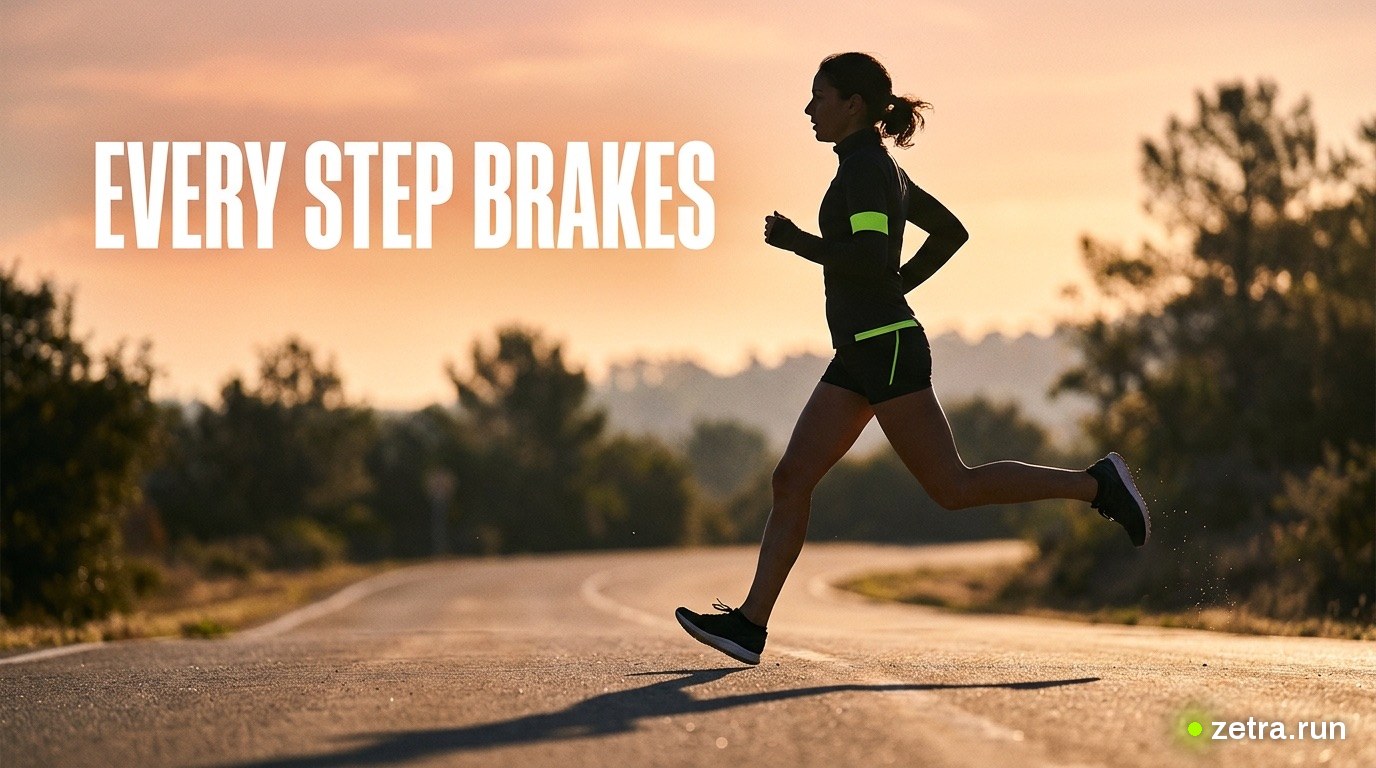
If your foot lands far ahead of you, your stride may be braking every step.
Overstriding is when your foot hits the ground too far in front of your body’s center of mass, often with a fairly straight knee and a loud heel-first landing. It can make running feel harsh, noisy, and harder than it needs to be. It may also add stress to your knees, shins, hips, or back because each step acts like a tiny stop sign before you roll forward again.
The fix is not to force a forefoot strike. Start smaller: raise your cadence slightly, think “land under me,” keep a gentle forward lean from the ankles, and use short hill strides to teach the position without overthinking it.
What is overstriding in running?
Overstriding means your foot lands too far ahead of your hips when you run.
A clean running stride is not about where your heel lands. It is about where your whole foot lands relative to your body. If your foot contacts the ground out in front of you, your leg is reaching forward. Your knee is often straighter than it needs to be. Your ankle may be flexed up. Your heel may slap the ground first.
That is the classic overstride shape.
You can heel strike and still not overstride. Many runners do. A heel strike becomes more of a problem when the foot is far ahead of the body and the leg is stiff. That position makes the ground push back against you instead of helping you move smoothly over it.
Think of it like this:
When your foot lands close under you, your body can roll over that foot.
When your foot lands far in front of you, your body has to catch up to that foot.
That catch-up moment is where the braking feeling comes from.
You might feel it as slappy feet. You might hear it before you feel it. A loud “smack, smack, smack” on an easy run often means your foot is reaching and landing with more force than needed. Not always. Shoes, surface, fatigue, and downhill running can change sound too. But if the slap comes with knee niggles or heavy legs, overstriding belongs on the suspect list.
Why does overstriding make running hurt?
Overstriding can make running hurt because it adds braking and impact to every step.
Running is a series of controlled landings. Each time your foot hits the ground, the ground pushes back. If your foot lands under your body, that force is easier to absorb and turn into forward movement. If your foot lands far ahead of you, part of that force pushes backward against your motion.
That is the plain physics.
You are trying to move forward. Your foot lands in front. The ground pushes against the foot. Your body has to pass over it before you can move freely again. Do that thousands of times, and a run can feel harder even if your pace is not fast.
Your knee may feel it because a straighter leg has less natural bend to absorb force. Your shin may feel it because the foot is reaching out and your lower leg has to control the landing. Your hip may feel it because the whole leg is acting like a brake. None of this means overstriding is the only reason runners get sore. Running pain is usually a mix of training load, strength, sleep, surface, shoes, history, and form. If you want the bigger picture, read why runners get injured.
But form still matters.
Overstriding is one of the few form issues you can often see, hear, and change without rebuilding your whole stride. That is good news. You do not need a lab. You need a phone, a little patience, and one change at a time.
How do I know if I am overstriding?
You know you might be overstriding if your foot lands visibly ahead of your hips, your steps sound loud, your cadence is low for your pace, or your knees feel beaten up after normal runs.
Do not diagnose from one clue. Use a few.
The easiest test is a side-view video. Put your phone on a bench, wall, bottle, or small tripod. Record yourself running past it at normal easy pace. Do not sprint. Do not “run pretty” for the camera. Run like you actually run when nobody is watching.
Pause the video at the moment your foot first touches the ground. Look at the foot that just landed. Is it far ahead of your hips? Is the knee nearly straight? Does your lower leg angle forward like you are reaching?
If yes, you may be overstriding.
Sound helps too. Loud landings do not automatically mean bad form. Some shoes are noisy. Some surfaces echo. But a slappy, sharp landing paired with a visible reach is useful information.
Cadence is another clue. Cadence means steps per minute. A very low cadence at an easy pace can mean you are taking long steps and spending too much time reaching in front. It does not prove overstriding, but it points you toward it. The old “180 steps per minute” rule is too rigid. Taller runners, slower paces, trails, hills, and fatigue all change cadence. Still, if your cadence is low and your foot lands way ahead of you, a small increase can help. For more on that, read cadence.
Here is a simple way to sort the signs.
| Sign | What it suggests | First fix |
|---|---|---|
| Loud slapping footstrike | You may be landing with a stiff leg or reaching ahead | Shorten the step slightly and run quietly for 30 seconds |
| Foot lands clearly in front of hips on video | Classic overstriding pattern | Cue “land under me” and raise cadence a little |
| Knee is almost straight at contact | Less bend available to absorb force | Think soft knee, quick feet |
| Cadence feels slow and bouncy | You may be spending too long in each stride | Add 3–5% more steps per minute for short blocks |
| Knee niggles after easy runs | Overstriding may be one contributor, not the whole cause | Reduce hard running, check form, and see a professional if pain persists |
How do I fix overstriding without overthinking every step?
Fix overstriding by changing the rhythm first, then the landing.
Do not start by staring at your feet. That usually makes you tense. You may paw at the ground, point your toes, or bounce on your calves. Instead, use cues that change the whole stride.
Start with short blocks inside an easy run. Form changes are tiring at first, even when they are small. Try 30 seconds at a time. Then relax for a few minutes. Repeat a few times.
First fix: raise cadence slightly
A slightly higher cadence often shortens your stride without you forcing it.
Do not chase a magic number. If your watch says 158 steps per minute, do not jump to 180 tomorrow. Try a small nudge. Think quick, light steps. If you use a metronome, set it just above your normal rhythm. If you do not, count steps for 30 seconds and add a few.
Your goal is not frantic feet.
Your goal is less reach.
A good cadence cue feels like your feet are touching down closer to your body. Your pace may stay the same. Your effort may even drop once the new rhythm settles. If your breathing spikes or your calves tighten, you changed too much. Back off.
Second fix: cue “land under me”
“Land under me” is better than “stop heel striking.”
The cue points your attention to the relationship that matters: foot under hips, not foot type. You can say it in your head every few minutes. Land under me. Quick feet. Soft knee.
Do not try to place your foot exactly below your hip. Running has motion. Your foot will land slightly ahead of your center of mass because your body is moving through space. The problem is the big reach, not a tiny forward contact.
Use the cue lightly. One or two words. Then run.
Third fix: lean slightly from the ankles
A gentle forward lean can help your foot land closer to you.
This is not bending at the waist. If you fold from the hips, your chest drops, your breathing feels cramped, and your stride can get messier. Think tall body, ribs stacked over pelvis, then a tiny lean from the ankles as if your whole body is falling forward by a few degrees.
You should not feel like you are tipping over. You should feel like your body is moving with the run instead of sitting behind your feet.
Try this on flat ground at easy pace:
Stand tall.
Relax your shoulders.
Let your ankles tip you forward slightly.
Start running before you feel the need to reach.
That last line matters. Overstriding often happens when your foot goes out to catch you. A small forward lean teaches your body to let the foot come down nearer to you instead.
Fourth fix: use short hill strides
Short uphill strides are a useful teacher because hills make overstriding harder.
Find a gentle hill. Not steep. After an easy warm-up, run 10 to 15 seconds uphill at a smooth, controlled effort. Walk back down. Repeat a few times.
On a hill, reaching far in front feels awkward. Your body naturally tends to use shorter steps, a little more cadence, and a stronger knee drive. That is the lesson you want. Keep it smooth. Stop before it turns into a sprint.
Downhills are different. They invite overstriding. If you are working on form, do not practice your “new stride” by bombing downhill. Keep downhill steps quick and controlled.
What should I not change if I think I overstride?
Do not force yourself onto your toes.
This is the mistake that causes the next problem.
You see a video of yourself heel striking. You read that heel striking is bad. Next run, you point your toes down and try to land on the forefoot. Your calves light up. Your Achilles gets cranky. Your pace feels strange. Now you have traded one stress for another.
Footstrike is an outcome. It changes when cadence, posture, speed, slope, shoes, and fatigue change. Some runners naturally land more on the heel. Some midfoot. Some forefoot. None of those patterns is automatically good or bad in every runner.
The better question is: where is your foot landing relative to your body?
If you keep landing far in front, forcing a forefoot strike does not solve the braking problem. You can overstride on your forefoot too. It just looks different and may load different tissues.
Also, do not make every run a form drill. Your body needs repetition, but it also needs easy miles that feel normal. Pick one cue. Use it briefly. Let it fade. Check again later.
And do not ignore pain. If pain changes your stride, gets worse during the run, lingers after, or keeps coming back, stop guessing and see a qualified medical professional.
How long does it take to fix overstriding?
You can feel a better stride in one run, but making it automatic usually takes repeated practice.
That does not mean months of obsessing over form. It means small exposures.
Try this for two weeks:
- On two easy runs each week, record a short side-view video before the run or after the warm-up.
- During the run, add four to six blocks of 30 seconds with quicker, quieter steps.
- Use one cue only: “land under me” or “quick feet.”
- Add a few short hill strides once a week if your body handles them well.
- Recheck video at the same easy pace.
Look for small changes. Less reach. Softer sound. Knee not locked at contact. Cadence slightly up without your effort jumping. Runs feeling smoother late, not just early.
If you try to fix everything at once, you will not know what worked. You may also make yourself stiff. Better form should feel smoother, not robotic.
Frequently asked questions
How do I know if I'm overstriding?
Record yourself from the side at easy pace and pause the video when your foot first touches the ground. If your foot lands clearly ahead of your hips, your knee is nearly straight, and your landing sounds loud or slappy, you may be overstriding. Cadence can support the clue, but video is more useful than a number alone.
Does overstriding cause knee pain?
Overstriding can contribute to knee pain because a straighter, forward-reaching leg may add braking and impact at each landing. But knee pain usually has more than one cause, including training load, strength, shoes, hills, and recovery. If pain persists, worsens, or changes how you run, see a professional.
Should I switch to forefoot running?
No, not as your first fix. Forcing a forefoot strike can overload your calves or Achilles, especially if you change suddenly. Focus on landing closer under your body, using a slightly quicker cadence and a soft knee. Your footstrike may shift naturally, or it may not need to.
Will shorter steps make me slower?
Shorter steps do not have to make you slower. Speed comes from stride length and cadence together. If your current stride is too long in front of you, shortening the reach can reduce braking while cadence rises slightly. The goal is not tiny steps. The goal is steps that land in a better place.
Can shoes fix overstriding?
Shoes may change how your landing feels, but they usually do not fix the pattern by themselves. A softer shoe can make a loud landing feel less harsh. A different drop can shift load. But if your foot still reaches far ahead of your body, the braking pattern remains. Change form gradually before blaming the shoe.
Overstriding is fixable because it is not a character flaw or a mystery injury. It is a timing problem: your foot is arriving too far ahead of the rest of you. If you want cadence, pace, and form cues handled while you run, Zetra coaches live in your ear and reacts to your pace, heart rate, and cadence in real time.
Run with a coach in your ear.
Zetra guides you live — heart rate, pace and cadence — on every run.