Why Plantar Fasciitis Can Make Running Hurt Early
By the Zetra Coaching Team
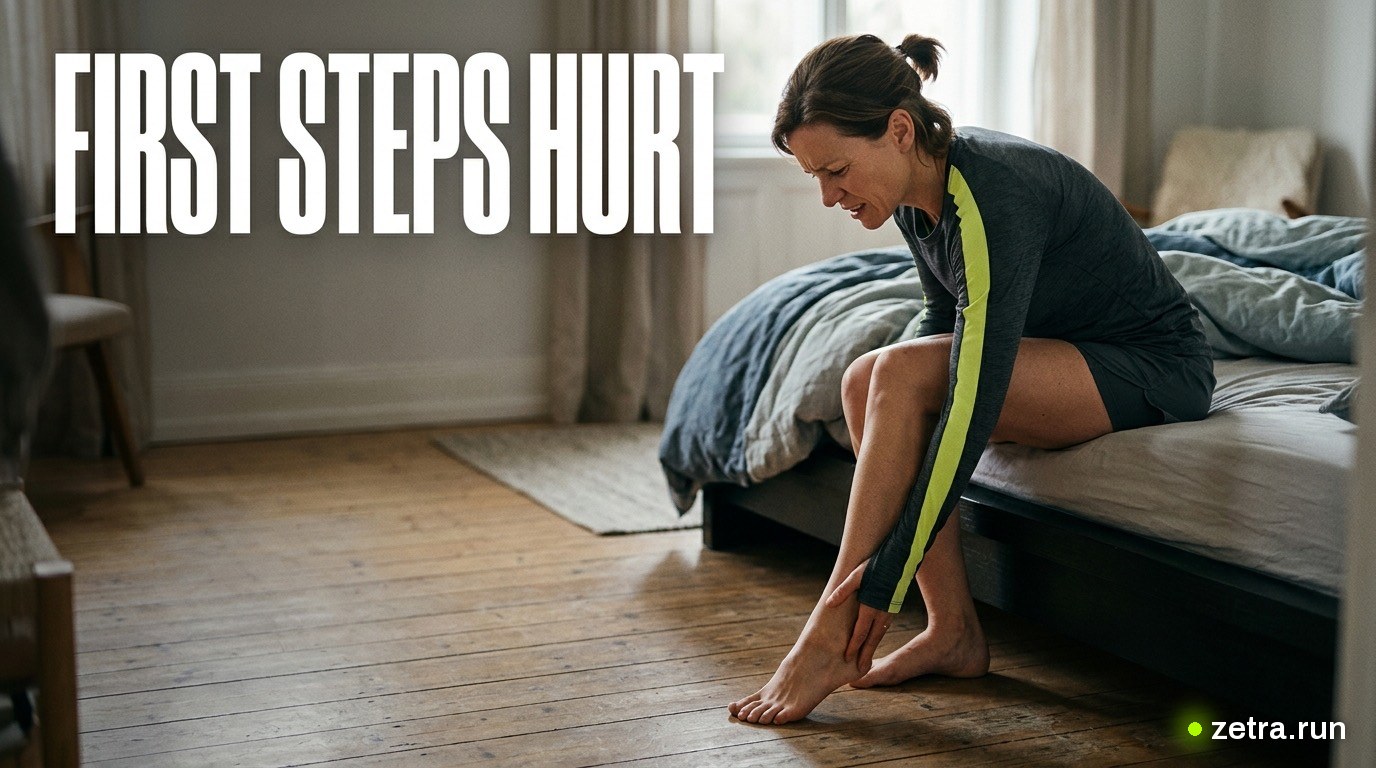
The clearest sign is not the run. It is the first few steps when you get out of bed.
That sharp, bruised, tearing, or hot pain under your heel happens because the tissue along the sole of your foot is being loaded before it is ready to tolerate that load. People often call this plantar fasciitis, but the name describes a pattern of pain, not a confirmed diagnosis. Several different problems can feel similar, which is why heel pain deserves more caution than many running niggles.
The classic pattern is pain under the heel or along the arch that feels worst with the first steps in the morning, or after sitting. It may ease once you warm up. Then it often comes back later, especially after running, standing, or walking on hard ground.
This article helps you understand the pattern and reduce load. It does not diagnose you, and it does not replace a physiotherapist or doctor.
What does plantar fasciitis feel like when you run?
Plantar fasciitis commonly feels like pain under the heel or through the arch that is worst after rest, eases as the foot warms up, then returns later.
That pattern matters.
If your heel hurts most during the first steps out of bed, then improves after moving around, you are seeing the signature clue. The tissue has been quiet overnight. Then you stand up, your body weight lands through the foot, and the sole has to take load again.
You may notice:
- A sharp spot under the heel
- A bruised feeling, like you stepped on a stone
- Tightness or pulling along the arch
- Pain after sitting, then standing again
- Pain that is calmer during an easy run but louder later
- More soreness after hills, speed work, long standing, or a sudden change in shoes
The confusing part is that the run itself may not feel terrible.
That is why runners get caught. You run, it warms up, you think it is fine, then the next morning your first steps tell the truth. The tissue tolerated enough to get through the run, but not enough to recover quietly afterward.
Heel pain is not always plantar fasciitis. Nerve irritation, stress injury, fat pad irritation, tendon problems, and other foot or ankle issues can overlap. If the pattern is not clear, or the pain is changing quickly, get assessed.
Why do the first steps in the morning hurt so much?
The first steps hurt because the plantar fascia and nearby tissues go from rest to full load almost instantly.
The plantar fascia is a thick band of tissue along the sole of your foot. It runs from the heel toward the toes, helps support the arch, and takes high load with every step. When you run, it does not just sit there like tape. It stores and releases force as your foot lands, rolls, and pushes off.
For a long time, plantar fasciitis was talked about like a simple inflammation problem. That can be misleading. Many clinicians now describe the problem more as tissue being loaded beyond what it currently tolerates. The exact biology can vary, and pain is never one simple thing, but for runners the practical message is clear:
Your foot is not weak in some moral sense. It is being asked for more than it can currently handle.
That “more” might be obvious. You added faster running. You returned after time off. You changed routes and now run more on cambered pavement. You started walking all day in flat shoes. You switched to a very different running shoe. You added hill reps. You increased total time on feet, not just training time.
Or it might be subtle.
A tired calf can shift more demand into the foot. A stiff big toe can change how you push off. A shoe that feels fine in the shop can feel different after repeated runs. A small increase in training load can stack on top of work, travel, poor sleep, and more standing than usual.
Pain after rest is one way the system tells you it is not coping yet.
Is plantar fasciitis inflammation or a load problem?
For runners, plantar fasciitis is best treated as a load tolerance problem unless a clinician tells you otherwise.
That does not mean inflammation never plays a role. It means the useful question is usually not “How do I kill inflammation?” The useful question is “What load is my foot failing to tolerate, and how do I bring that load back in a way it can adapt to?”
This matters because complete rest can feel logical but still leave you stuck. If you stop everything until the pain disappears, then jump straight back to normal running, the tissue may meet the same load again and complain again.
The other mistake is the opposite: pretending that warming up means healing.
If pain eases during a run but comes back harder later, that is not a green light. That is information. The foot may be able to handle some load, but not the amount, intensity, surface, or footwear you are giving it right now.
Think in terms of total foot demand:
- Running volume
- Running intensity
- Hills
- Speed work
- Hard surfaces
- Long standing
- Walking in unsupportive footwear
- Sudden shoe changes
- Calf and foot strength capacity
- Recovery between loading days
Your job is not to panic. Your job is to reduce the aggravating load enough that the foot can settle, then rebuild capacity with patience.
When should you stop running and see a professional?
You should stop self-managing and see a physiotherapist or doctor if the pain is severe, unusual, worsening, or not behaving like the typical first-step pattern.
Heel pain has several possible causes. A professional assessment matters more here than with many small aches because the wrong assumption can keep you loading the wrong problem.
Get checked rather than guessing if you notice:
- Pain that is sharp, severe, or getting worse run to run
- Pain that does not ease after warming up
- Pain that changes your walking pattern
- Swelling, redness, heat, numbness, or tingling
- Pain after a fall, twist, or sudden incident
- Pain that is present at rest or wakes you at night
- Pain on both sides with other new symptoms
- Pain that keeps returning despite sensible load reduction
- Any concern that this could be more than a running niggle
Also see a professional if you are unsure. That is not overreacting. It is cheaper than months of guessing.
For a broader guide on when pain deserves attention, read pain red flags.
Can you keep running with plantar fasciitis?
You may be able to keep running if symptoms are mild, predictable, and not worse afterward, but you should reduce the aggravating load and watch the next morning carefully.
The next morning is often the report card.
If your first steps are calmer after a run, that run was probably within your current tolerance. If your first steps are sharper, longer-lasting, or spreading through the arch, the load was likely too much.
Do not judge only the run. Judge the response.
Here is a simple way to think about what you notice.
| What you notice | What it commonly indicates | Sensible first response |
|---|---|---|
| First steps hurt, then ease as you move | Classic irritated plantar fascia pattern, though not a diagnosis | Reduce aggravating load and monitor the next morning |
| Pain warms up during the run but returns later | The foot may tolerate some load, but not the current total dose | Shorten, slow, flatten, or skip harder sessions |
| Pain gets sharper as the run goes on | The load may be too high right now | Stop the run and get assessed if it repeats |
| You limp or change your stride | The pain is altering mechanics | Stop self-managing and see a professional |
| New numbness, tingling, swelling, or night pain | Could be something other than the usual pattern | See a physiotherapist or doctor |
“Reduce load” does not always mean “do nothing.” It might mean easier running, fewer hills, less speed work, more recovery between runs, or replacing some running with lower-impact movement if that feels acceptable. It might also mean cutting down long walks or standing time for a while, because your foot does not know whether the load came from training or life.
The key is honesty.
If every run makes tomorrow morning worse, you are not managing it. You are negotiating with a foot that already answered.
What helps plantar fasciitis settle without complete rest?
What tends to help is reducing the load that keeps provoking the heel while building the calf and foot capacity to handle running again.
There is no magic switch. This condition is often stubborn. It commonly takes weeks rather than days, and some cases take much longer. Runners routinely expect a two-week fix, start doing sensible things, feel only partly better, then abandon the plan right before it had a chance to work.
Patience is part of the treatment environment.
The big rocks are simple, even if they are not easy.
Reduce the irritating load first
Look for the thing that changed before the pain started.
Did you add faster running? More hills? A new route? More pavement? A different shoe? More walking at work? More time barefoot at home? A return to training after a break?
You do not need to find one villain. Often it is the stack.
Start by calming the stack. Keep the running you can tolerate, if you can tolerate any, and remove the obvious spikes. Hard sessions are usually a poor bargain when the heel is already irritable. Hills can ask a lot from the calf and foot. Long time on hard surfaces can keep the area sensitized.
For footwear changes, be especially careful. A shoe with a very different feel can change how your foot loads, even if it is a good shoe. If you recently changed shoes and the timing matches the pain, consider whether that change was too abrupt. For more on matching shoes to your running, read running shoes.
Build strength in the calf and foot
Calf and foot strength work commonly helps because the plantar fascia does not work alone. Your calf, ankle, foot muscles, and big toe all influence how force moves through the sole.
This is not about punishing the sore spot. It is about gradually improving the system around it.
A professional can help you choose the right starting point. That matters because the right exercise at the wrong dose can still be too much. The goal is a level of loading the foot can recover from, not a heroic routine that flares it up.
If you want the bigger picture, see strength training for runners. The principle is the same: stronger tissues usually tolerate running better, but they need time and sensible progression.
Watch surfaces and daily footwear
Runners often focus only on training, then spend the rest of the day feeding the problem.
Hard floors. Long standing. Barefoot time when the heel is angry. A sudden switch to minimal shoes. A holiday with lots of walking. A job that keeps you on your feet.
None of these are automatically bad. They are load. When the foot is irritated, they count.
Your running shoes also count. So do the shoes you wear outside running. Support, cushioning, stiffness, and heel-to-toe feel can change symptoms for some runners. There is no single best shoe for every sore heel, and anyone promising that is overselling it. What matters is whether your foot responds better or worse.
How do you know plantar fasciitis is improving?
You know it is improving when the first-step pain is less intense, settles faster, and does not rebound after normal daily load.
Look for trends, not perfect days.
A good sign is that you get out of bed and notice the heel, but it feels duller. Or it takes fewer steps before your gait feels normal. Or you can run easy and the next morning is no worse. Or you can stand through a normal day without that familiar return of heat under the heel.
A bad sign is the opposite. The sore area spreads. Morning pain lasts longer. You start limping. You need to change your stride to get through runs. The pain that used to warm up now stays loud.
Progress with plantar fasciitis can be boring. That is why runners struggle with it. You may not get a clean “all better” moment. You may get a slow widening of what your foot can tolerate.
That counts.
Do not chase the first good day. A calmer heel is an invitation to keep building, not to test everything at once.
Frequently asked questions
What does plantar fasciitis feel like?
Plantar fasciitis commonly feels like pain under the heel or along the arch, especially with the first steps in the morning or after sitting. It may feel sharp, bruised, hot, or tight. It often eases as you warm up, then returns later. That pattern is suggestive, but it is not a confirmed diagnosis.
Can I keep running with plantar fasciitis?
You may be able to keep running if the pain is mild, predictable, and not worse afterward or the next morning. If running makes the first steps sharper, changes your stride, or keeps escalating, reduce the load and see a professional. Do not use the warm-up effect as proof that the foot is fine.
How long does plantar fasciitis last?
Plantar fasciitis commonly takes weeks rather than days, and some cases take much longer. No timeline is a promise. The cases that drag on often involve repeated load spikes, sudden returns to full training, or giving up on a sensible plan too early because it did not work fast enough.
Do insoles help plantar fasciitis?
Insoles may help some runners by changing pressure or support, but they are not a guaranteed fix and they do not replace load management. Avoid thinking of them as the whole answer. If you need them to walk normally, or you are unsure what kind makes sense, get assessed.
What shoes are best for plantar fasciitis?
The best shoes are the ones your foot tolerates well right now. Some runners prefer more cushioning or support when the heel is irritated. Others do better with a shoe that simply feels stable and familiar. Avoid sudden changes, especially when symptoms are active, and be cautious with any shoe that makes the first-step pain worse later.
Heel pain asks for patience and better feedback, not panic. If you are running through first-step pain and guessing what changed, Zetra can help you adjust live during the run by reacting to heart rate, pace, and cadence in real time, while you keep the bigger injury decisions with a qualified professional.
Run with a coach in your ear.
Zetra guides you live — heart rate, pace and cadence — on every run.