Heart Rate Higher in Hot Weather? Run by Effort
By the Zetra Coaching Team
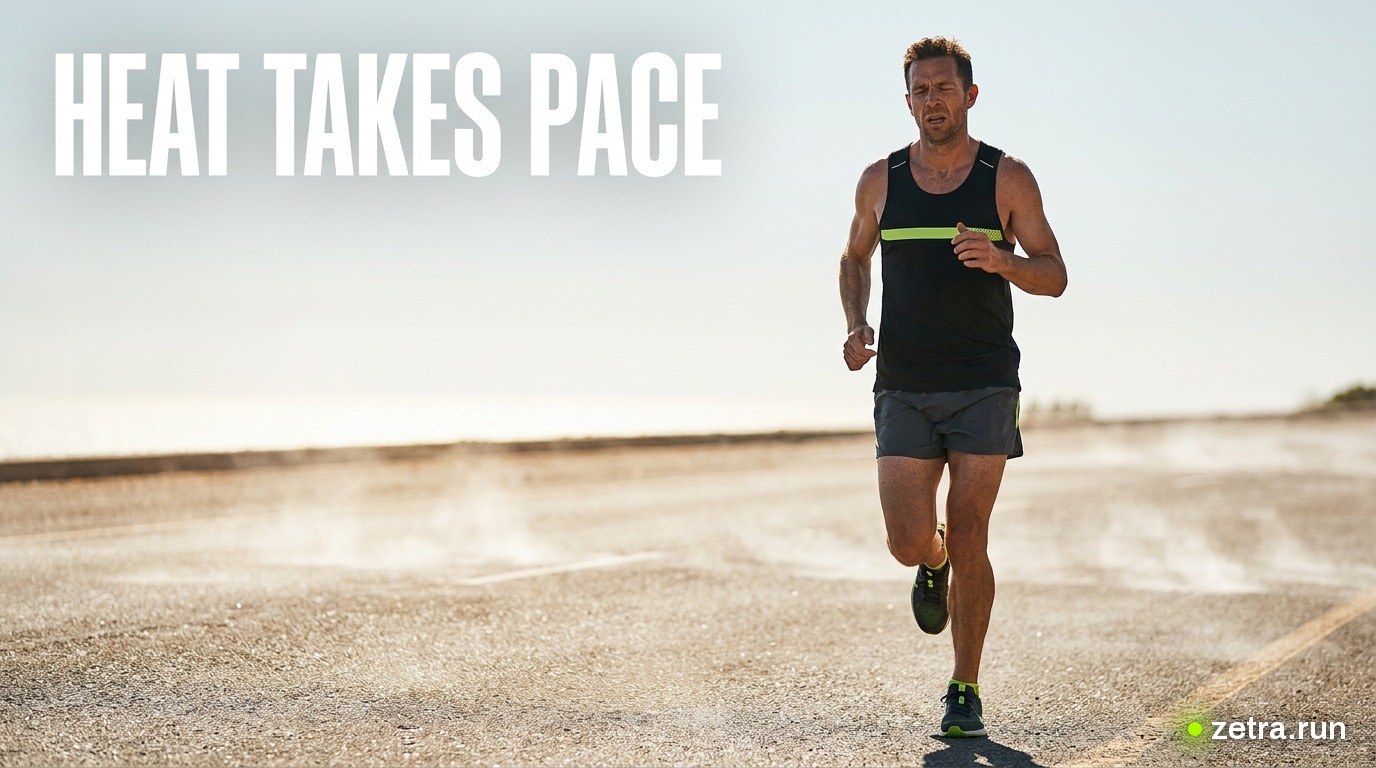
Summer arrives and your easy run quietly becomes a hard one without you changing anything.
Your heart rate is higher in hot weather because your body is doing two jobs at once: sending oxygen-rich blood to your working legs and sending more blood to your skin to dump heat. As you sweat, your blood volume can also drop, so your heart has to beat faster to move the same amount of oxygen around. The same pace genuinely costs more.
That means the conflict is real. If you hold your usual easy pace, your heart rate may drift out of the easy zone. If you hold the zone, your pace may feel painfully slow. For easy runs, the better choice is usually to hold the effort or heart rate zone and accept the slower pace.
Why is my heart rate higher when running in hot weather?
Your heart rate rises in heat because cooling becomes part of the workout.
On a cool day, most of your running effort goes toward moving you forward. Your muscles ask for oxygen. Your heart pumps blood. Your breathing settles. Your easy pace feels like easy pace.
In heat, your body has another problem to solve: keeping your core temperature from climbing too far. To do that, it sends more blood toward the skin, where heat can leave the body. You also sweat, which helps cool you when that sweat evaporates.
That is the plain version.
Here is what it feels like on the run:
- Your breathing is fine at first, then slowly gets more ragged.
- Your watch shows a heart rate that looks too high for the pace.
- Your legs may not feel terrible, but the whole run feels heavier.
- A route that usually feels comfortable now feels like work.
This is not a fitness failure. It is not proof that your training has vanished. It is your body paying the heat cost.
A useful way to think about it: in hot weather, your heart is splitting its attention. Some blood goes to the muscles so you can run. Some blood goes to the skin so you can cool down. If you keep asking for the same pace, your heart often has to beat faster to cover both jobs.
Sweat adds another layer. As you lose fluid, the liquid part of your blood can drop. With less circulating volume, each heartbeat may move a little less blood than usual. Your heart rate rises to keep oxygen delivery going.
That is why “same pace, higher heart rate” is a normal summer pattern.
For the bigger heat-running picture, see running in the heat. For the zone side, see heart rate zones running.
Should I follow pace or heart rate when it is hot?
For easy running in the heat, follow heart rate or effort first and let pace slow down.
Easy runs are supposed to build aerobic fitness without adding too much stress. If your easy run turns into zone 4 just because you refuse to slow down, it is no longer an easy run. It has become a harder workout wearing an easy-run label.
That matters because easy running only works when it is actually easy.
If your plan says easy, your job is not to protect the pace on your watch. Your job is to protect the purpose of the run. In summer, that often means slowing down, shortening the run, choosing a flatter route, taking shade where you can, or using walk breaks before your heart rate runs away.
This can feel annoying.
You might look down and think, “This pace is embarrassing.” But your body does not care what the watch says compared with spring. It cares about stress. Heat is stress. If you add heat stress and pace stress together, the run becomes much harder than planned.
Heart rate is not perfect in heat. Wrist sensors can lag or misread. Caffeine, poor sleep, dehydration, hills, and life stress can all push the number around. But if the trend is clear and your easy zone keeps turning into zone 4, believe the pattern.
Use three checks together:
- Heart rate: Is it staying near the intended zone, or climbing steadily?
- Breathing: Can you speak in short sentences without forcing it?
- Control: Could you keep going calmly, or are you bargaining with yourself early?
If all three say the run is too hard, slow down.
What should I change when my easy pace becomes zone 4?
Change the run before you fight the watch.
You do not need a dramatic new system for summer. You need a few simple adjustments that match the conditions.
| Conditions | What happens to heart rate at your usual easy pace | How to adjust the run |
|---|---|---|
| Warm, dry, light breeze | Heart rate may rise sooner than usual, but the run can still feel controlled | Start slower than normal and let the first part of the run feel almost too easy |
| Hot and sunny | Heart rate often climbs even when pace feels familiar | Choose shade, slow down early, and protect the easy zone instead of chasing pace |
| Humid and still | Heart rate can drift higher because sweat does not evaporate well | Treat the run as harder than the temperature suggests; reduce pace or move the run |
| Heat after a cool training block | Heart rate may jump because you are not adapted yet | Give your body regular exposure and expect pace to be slower for now |
| You feel dizzy, nauseous, chilled, confused, or you stop sweating | This is no longer normal training stress | Stop immediately, get out of the heat, cool down, and get help |
The key move is early restraint.
Do not wait until your heart rate is already high and your breathing is ragged. In heat, the cost builds. If you start at your normal cool-weather pace, you may spend the rest of the run trying to rescue it.
Start easier than you think you need to. Let your body settle. If your heart rate stays calm, you can keep rolling. If it climbs anyway, you have room to adjust.
Walk breaks are not failure here. They are a tool. If a short walk keeps the whole run in the right effort range, it has done its job.
Hydration matters too, especially on longer or hotter runs. You do not need to overthink every sip, but you do need to avoid starting already dehydrated and then pretending heat does not count. For a practical guide, read how much to drink running.
How should I run workouts in the heat?
For hard sessions in heat, use effort first and adjust the targets.
Easy runs and workouts have different jobs. Easy runs should stay easy. Workouts are meant to create a controlled hard stimulus. Heat makes that control harder.
If you try to hit your normal cool-weather pace in hot conditions, the session may become harder than intended very quickly. The first rep feels fine. Then your heart rate climbs. Recovery stops working. Your form gets sloppy. By the end, you are not training the system you meant to train. You are just surviving the weather.
Most coaches handle this by adjusting the target. That may mean running the same workout by effort instead of pace, cutting the session short, lengthening recoveries, choosing a shaded route, or moving the workout indoors.
Effort-based pacing is not vague if you use it honestly.
A hard but controlled interval should feel hard but repeatable. You should finish knowing you worked, not feeling like the heat beat you into the ground. A tempo-style effort should feel steady and contained, not like a race you regret starting. If the effort turns frantic early, the target is wrong for the day.
Heart rate can help, but it may lag during shorter hard efforts. In heat, it may also stay elevated during recoveries. That does not make it useless. It means you should not use it as the only judge.
For workouts, ask:
- Can I hold my form?
- Is my breathing hard but controlled?
- Are recoveries actually recovering me?
- Is the heat changing the purpose of the session?
If the answer turns against you, adjust. A slightly slower workout done well is better than forcing a pace until the session falls apart.
How long does heat acclimatisation take?
Heat acclimatisation commonly takes about one to two weeks of regular exposure.
That does not mean you become heatproof. It means your body gets better at handling heat stress. You may start sweating earlier. Your heart rate at a given effort may settle compared with the first hot runs. The same conditions may feel less shocking.
But adaptation has limits.
Humidity can still make a moderate day feel brutal. Direct sun can change the run. Poor sleep, hard training, travel, and dehydration can all reduce your tolerance. Being acclimatised helps. It does not give you a free pass to ignore warning signs.
The safest way to adapt is boring and consistent. Get regular exposure without turning every run into a test. Keep easy runs easy. Avoid proving toughness during the first hot stretch of the season. Let your body catch up.
If summer arrives suddenly, expect your watch to look strange for a while. Your heart rate may be higher than you want. Your pace may drop more than your ego likes. That is normal.
The mistake is treating the first hot week like a fitness exam.
It is not an exam. It is a new condition.
Why does humidity make running feel so much harder?
Humidity makes running harder because sweat cannot cool you as well when the air is already full of moisture.
Sweating is only useful when sweat evaporates. Evaporation pulls heat away from your body. In dry air, that process works better. In humid air, sweat can sit on your skin and drip off without cooling you as effectively.
That is why a humid run can feel worse than the temperature suggests. Your shirt is soaked. Your skin feels sticky. Your breathing feels compressed. Your heart rate climbs even though the pace is not ambitious.
Humidity also makes pacing harder because your normal cues can be misleading. You may start the run thinking, “It is not that hot.” Then the lack of cooling catches up. Your heart rate drifts. Your effort rises. The easy run turns into a grind.
Treat humid days with extra respect.
Run earlier if the air is cooler. Choose shade. Keep the route simple so you can stop or shorten the run if needed. If the day feels oppressive before you start, it probably will not become friendly halfway through.
This is where discipline looks like backing off.
When is heat discomfort a warning sign?
Heat discomfort is common. Heat danger is different.
Normal discomfort can include heavy sweating, a higher heart rate, slower pace, and a run that feels harder than usual. You can still think clearly. You can control your effort. You can slow down and feel better.
Warning signs are not something to negotiate with.
If you stop sweating, get chills, feel confused, dizzy, or nauseous in the heat, stop immediately and get help. Get out of the heat if you can. Cool down. Do not try to finish the run. Do not wait to see if it passes while you keep moving.
Chest pain, fainting, severe weakness, or symptoms that do not settle also need urgent help. If something feels wrong in a way that is beyond normal running discomfort, treat it seriously.
There is no training benefit in pushing through heat illness.
You are not losing fitness by stopping. You are making the only useful decision available.
Frequently asked questions
Why is my heart rate higher when running in heat?
Your heart rate is higher in heat because your body is sending blood to your working muscles and to your skin for cooling at the same time. As you sweat, fluid loss can also reduce blood volume, so your heart beats faster to keep oxygen moving. The same pace costs more in hot weather.
Should I slow down to stay in zone 2 in summer?
Yes, for most easy runs, you should slow down enough to keep the run easy, even if that means your pace drops. If the goal is zone 2, protecting the zone matters more than protecting your usual pace. Use breathing and effort as a check, not just the watch.
How long does heat acclimatisation take?
Heat acclimatisation commonly takes about one to two weeks of regular exposure. You may feel better and see a calmer heart rate after consistent hot-weather running, but you are not immune to heat. Keep adjusting for conditions.
Does humidity affect heart rate?
Yes. Humidity can raise heart rate because sweat does not evaporate as well, so your body has a harder time cooling itself. When cooling is less effective, the same pace can feel harder and push your heart rate higher.
Should I run indoors when it is very hot?
Sometimes, yes. If heat or humidity makes the run unsafe or changes the workout too much, running indoors is a good adjustment. This is especially true for harder sessions, long runs, or days when you already feel run down before starting.
Summer running gets easier when you stop treating hot-weather pace like a verdict. The same pace costs more because your body is cooling and running at the same time. Hold the right effort, accept the slower days, and adjust hard sessions before the heat turns them into something else. Zetra can help by reacting to heart rate, pace, and cadence live during the run, so you know when to back off while it still matters.
Run with a coach in your ear.
Zetra guides you live — heart rate, pace and cadence — on every run.